Have you ever wondered why you continue to repeat certain habits and behaviors even when you know they’re preventing you from reaching your goals? Maybe you procrastinate on important projects, constantly overcommit yourself, or struggle to follow through on the plans you’ve made. You know what you need to do, and you genuinely want to make progress, but somehow you keep finding yourself stuck in the same frustrating patterns.
It’s easy to assume these productivity issues are caused by a lack of discipline, motivation, or time management skills. But what if some of these behaviors are actually connected to unconscious beliefs and emotional needs you haven’t fully acknowledged?
This is where Shadow Work can become an important tool for improving your productivity and creating meaningful change in your life.
What Is Shadow Work?
Shadow Work is a practice of self-reflection that involves exploring the hidden or unconscious aspects of your personality, including beliefs, fears, desires, and emotions you may have learned to suppress, ignore, or reject.
The concept of the shadow self is commonly associated with psychologist Carl Jung, who believed that aspects of ourselves we don’t consciously identify with can still influence our thoughts, feelings, and behaviors.
Although we often think of our shadow as representing negative qualities, it can also contain unmet emotional needs, hidden desires, and parts of ourselves that we haven’t learned to accept.
The purpose of Shadow Work isn’t to eliminate these parts of ourselves or judge them as wrong. Instead, it’s to develop greater self-awareness so we can understand why we behave the way we do and make more intentional choices.
When we apply this practice to productivity, we can begin to recognize the unconscious patterns that may be influencing our ability to manage our time, maintain positive habits, and follow through on our goals.
How Your Shadow Self May Be Influencing Your Productivity
After reading Existential Kink by Carolyn Elliott, I began to see Shadow Work as an especially valuable practice for understanding productivity issues and self-sabotaging behaviors.
One of the central ideas explored in the book is that we may sometimes experience an unconscious sense of pleasure, satisfaction, or emotional reward from circumstances and behaviors that we consciously claim to dislike.
This is an uncomfortable idea to consider, particularly when we’re dealing with problems that genuinely frustrate us. However, it invites us to look beyond the obvious explanations for our behavior and consider whether certain habits might be fulfilling emotional needs we haven’t recognized.
For example, consider someone who consistently procrastinates until the last minute. On the surface, this appears to be a time management problem. But perhaps that person also enjoys the adrenaline rush of working under pressure. The urgency creates excitement, focus, and a sense of accomplishment that they struggle to experience when working at a more relaxed pace.
Or consider someone who is constantly overwhelmed by responsibilities and complains that they never have enough time to pursue their personal goals. While their schedule may genuinely be demanding, staying busy might also provide a convenient way to avoid the discomfort of taking risks, making changes, or pursuing something that feels intimidating.
These examples don’t mean that every productivity struggle has an unconscious emotional cause or that we’re responsible for every difficult circumstance in our lives. They simply demonstrate how some of our habits may be reinforced by emotional rewards we haven’t considered.
By becoming aware of these patterns, we can begin addressing the underlying needs instead of repeatedly trying to solve everything with more discipline or a better schedule.
6 Shadow Work Prompts to Uncover Your Productivity Blocks
If you’re curious about how your shadow self might be influencing your productivity, here are six questions to explore through journaling or personal reflection.
1. What do I secretly gain from procrastinating?
Does waiting until the last minute give me an adrenaline rush, help me avoid uncomfortable emotions, or provide an excuse if things don’t turn out as planned?
2. How does being constantly busy benefit me?
Does having an overwhelming schedule make me feel important, needed, or productive? Could my busyness be protecting me from pursuing something I genuinely want?
3. How much of my self-worth is tied to how much I accomplish?
Do I feel guilty when I’m resting? Do I need to be productive to feel valuable, deserving, or worthy of recognition?
4. What am I afraid might happen if I actually achieve my biggest goals?
Would success bring new responsibilities, expectations, visibility, or changes to my relationships? Is there a part of me that feels safer staying exactly where I am?
5. What excuses or stories do I repeatedly tell myself when I’m not making progress?
Are these explanations always true, or might some of them be protecting me from taking responsibility, facing discomfort, or risking failure?
6. Do I secretly believe that success has to be difficult to be meaningful?
When something comes easily to me, do I question its value? Do I unconsciously create unnecessary challenges because I believe struggle makes success more deserving?
As you reflect on these questions, remember that the goal isn’t to criticize yourself or force a particular answer. It’s to become curious about your behavior and identify patterns that may deserve more attention.
You might discover that some habits are connected to fears or emotional needs you haven’t fully acknowledged. You might also recognize that certain productivity challenges are simply the result of unrealistic expectations, insufficient resources, or systems that aren’t working for your current circumstances.
Both types of insight can help you make better decisions about how to move forward.
Why Shadow Work Requires Self-Compassion, Not Judgment
One of the biggest challenges with Shadow Work is that it can bring up feelings of embarrassment, guilt, or shame.
After all, admitting that we might be contributing to our own problems isn’t always comfortable. It can be especially difficult to consider that certain frustrating behaviors might provide us with a sense of comfort, security, or satisfaction.
But approaching these discoveries with shame or harsh self-criticism usually isn’t helpful.
Instead, we want to practice acknowledging our patterns without immediately judging ourselves for having them.
For example, if you recognize that being constantly busy makes you feel important or needed, you don’t need to criticize yourself for wanting recognition. Wanting to feel valued is a perfectly understandable human need.
The more useful question is whether there are healthier ways to meet that need without overcommitting yourself and sacrificing your personal priorities.
Similarly, if you realize that last-minute pressure helps you feel energized and motivated, you don’t necessarily need to eliminate your desire for excitement. You might simply need to create more intentional ways to generate momentum, such as timed focus sessions, productivity challenges, or shorter deadlines.
The goal of Shadow Work is to understand the needs behind our behaviors so we can begin meeting those needs in ways that support the lives we actually want to create.
This process is sometimes called shadow integration, and it involves learning to acknowledge and work with the parts of ourselves we’ve previously ignored or rejected.
Turning Self-Awareness Into Better Productivity Habits
Recognizing your unconscious patterns is an important first step, but awareness alone doesn’t automatically create lasting change.
Once you understand why you might be repeating a particular behavior, the next step is to develop practical strategies, habits, and routines that support a different way of operating.
For example, if you’ve recognized that you rely on last-minute pressure to motivate yourself, you might experiment with scheduling focused work sessions earlier in the week rather than waiting for a deadline to become urgent.
If you’ve discovered that constant busyness helps you avoid pursuing your bigger goals, you might need to establish stronger boundaries, reduce unnecessary commitments, and intentionally schedule time for your most meaningful objectives.
If you associate productivity with self-worth, you may benefit from creating routines that prioritize rest, recovery, and sustainable progress rather than measuring your success by how exhausted you feel at the end of the day.
And if you’ve realized that achieving your goals feels intimidating because of the changes success might bring, you can begin breaking those goals into smaller, manageable steps that allow you to build confidence along the way.
This is where I believe Shadow Work and functional planning can work particularly well together.
Shadow Work helps you understand the beliefs and emotional patterns influencing your behavior, while functional planning provides the practical structure you need to turn that understanding into consistent action.
When you combine self-awareness with effective planning systems, you give yourself an opportunity to make progress without continually relying on pressure, guilt, or willpower.
You Don’t Have to Overcome Your Productivity Challenges Alone
Developing greater self-awareness and building positive habits takes time, practice, and consistency. Even when we understand what’s holding us back, it can be difficult to recognize our patterns in the moment or determine which strategies will help us make lasting changes.
That’s why having access to guidance, accountability, and a supportive community can be so valuable.
Inside the Charmed Life Master Mind, we focus on helping women become more intentional, organized, and productive by combining practical planning strategies with the personal development work that supports meaningful growth.
Through our monthly Office Hours coaching calls, we explore topics like Shadow Work, mindset, goal achievement, productivity challenges, and the habits that influence our ability to create the lives we want.
Our Master Mind is designed to give you access to coaching, accountability, strategies, and resources that help you develop positive, productive habits and routines that work for your lifestyle.
Whether you’re struggling with procrastination, overwhelmed by your responsibilities, or simply ready to become more consistent with your goals, you don’t have to figure everything out on your own.
You’ll have a supportive community of like-minded women working toward their own goals, along with practical tools and guidance to help you stay focused, overcome obstacles, and make meaningful progress.
Because becoming a Well Planned and Productive Woman isn’t about pushing yourself harder or expecting perfection. It’s about understanding yourself, creating systems that support your priorities, and learning how to make consistent progress with greater ease and intention.
Join the Charmed Life Master Mind
If you’re ready to stop getting in your own way and start developing the habits, routines, and mindset that support your goals, I’d love to welcome you into the Charmed Life Master Mind!
Our annual membership is currently on sale for just $333, giving you access to an entire year of coaching, accountability, planning strategies, and personal development resources to help you create a more organized, intentional, and productive life.
Join us and start building the systems, habits, and self-awareness you need to make meaningful progress toward your goals.
It’s Monday evening, and if today wasn’t as productive as you’d hoped, you might already feel like you’re falling behind this week. Maybe you had a long to-do list that barely got touched, unexpected interruptions threw off your schedule, or you simply struggled to find the motivation and focus you needed to get things done.
Whatever the reason, it’s easy to look at an unproductive Monday and feel like you’ve already wasted your opportunity to have a successful week. But here’s something important I want you to remember: One unproductive day doesn’t mean you’re going to have an unproductive week!
You don’t have to wait until next Monday to get yourself back on track. Every day is an opportunity for a fresh start, and with a little reflection and intentional planning, you can turn things around as early as tomorrow.
If your week hasn’t started as productively as you’d like, here are three simple questions to ask yourself tonight to reset your focus and make tomorrow a more productive day.
1. What Did I Hope to Accomplish Today That I Didn’t Get Done?
The first step to getting back on track is taking an honest look at what you intended to accomplish today versus what actually got done.
Think about the tasks, projects, or responsibilities you planned to complete but didn’t get around to. Instead of feeling guilty about what you didn’t accomplish, take a few minutes to write those unfinished tasks down so you can get them out of your head and onto paper.
This is also a great opportunity to consider why certain tasks didn’t get completed. Did you underestimate how much time something would take? Were you distracted by unexpected responsibilities? Or did you simply have too much on your schedule to begin with?
Understanding what got in the way can help you make more realistic plans moving forward.
2. Which of These Tasks Would Make the Biggest Difference If I Completed Them Tomorrow?
Once you’ve identified what didn’t get done, it’s time to determine what actually deserves your attention tomorrow.
One of the biggest mistakes people make when they have an unproductive day is trying to compensate by adding everything they didn’t finish to the next day’s to-do list. Unfortunately, this often creates an overwhelming schedule that sets you up to fall behind all over again.
Instead, review your unfinished tasks and ask yourself which ones would make the biggest difference if you completed them tomorrow.
Not everything needs to become tomorrow’s priority. Focus on the tasks that will help you make the most meaningful progress toward your goals, meet important deadlines, or eliminate unnecessary stress.
I recommend choosing your top three priorities for tomorrow so you have a clear direction for your day without overwhelming yourself with unrealistic expectations.
3. What Can I Do Tonight to Make It Easier to Follow Through Tomorrow?
Now that you know what you want to accomplish tomorrow, think about what you can do tonight to make those tasks easier to complete.
Sometimes the difference between a productive day and an unproductive one comes down to how well we’ve prepared ourselves in advance.
For example, you might spend a few minutes organizing your workspace, gathering the materials you need for an important project, reviewing your schedule, or deciding when you’ll work on your top priorities.
These small preparations can help eliminate unnecessary decisions and distractions so that when tomorrow arrives, you’re ready to get started.
Remember, you don’t need to spend your entire evening preparing for the next day. Even 10–15 minutes of intentional planning can help you feel more organized, focused, and confident about what you need to accomplish.
Remember, You Can Have a Fresh Start Tomorrow!
If your Monday didn’t go according to plan, don’t let that discourage you from making the rest of your week a success.
Productivity isn’t about having a perfect schedule or completing every single task on your to-do list. It’s about making intentional decisions with your time and energy so you can consistently move forward toward the things that matter most.
Some days will naturally be more productive than others, and that’s okay. What matters is that you don’t allow one difficult or disappointing day to derail your progress.
You don’t need a new week to make a fresh start. You just need a new plan!
So take a few minutes tonight to reflect on what didn’t get done, identify your most important priorities, and prepare yourself for a better tomorrow.
You might be surprised how quickly you can turn your week around with a little intentional planning.
Ready to Become a More Well Planned & Productive Woman?
If you’re tired of feeling like you’re constantly playing catch-up and you’re ready to start approaching your days with more intention, clarity, and purpose, I have a free resource to help you get started!
This guide is designed to help you take the first steps toward becoming the well planned and productive woman you know you can be, so you can spend less time feeling overwhelmed and more time making meaningful progress toward your goals.
Because productivity isn’t about doing more. It’s about making a plan that helps you accomplish more of what truly matters.
Download your FREE Well Planned & Productive Woman Essential Planning Guide today and start creating your more productive, well planned life!
What if spending just a little extra time on a few simple activities this weekend could save you hours of work, stress, and decision-making next week?
One of my favorite Soft Productivity principles is that what you do today builds the results you experience tomorrow.Every little action you take to prepare, organize, or simplify your life is an investment in your future self. And the beautiful thing is that these investments don’t have to require a tremendous amount of time or energy to make a meaningful difference.
In fact, some of the most effective productivity strategies are the ones that fit naturally into the routines and activities you’re already doing.
Think about it. You’re probably going to cook a meal, do some laundry, run errands, or spend a little time relaxing this weekend anyway. What if you could use those same activities to get a head start on the week ahead without adding much more work to your plate?
That’s exactly what we’re going to do with these seven Soft Productivity weekend activities. Each one can be completed in two hours or less, and many take just 15–30 minutes. The goal isn’t to spend your entire weekend preparing for Monday. It’s to make a few intentional choices that will help your upcoming week run more smoothly.
Let’s get into it!
1. Meal Prep Proteins for the Week Ahead
One of the easiest ways to save yourself time during the workweek is to prepare a few versatile proteins in advance. And you don’t need to spend your entire Sunday cooking elaborate meals or filling dozens of containers to make meal prep worthwhile.
Instead, try preparing extra protein while you’re already cooking a meal this weekend. If you’re making chicken for dinner, cook a few additional portions. If you’re browning ground beef for tacos, prepare another pound to use later. You could also put a pork loin or several chicken breasts into a slow cooker and let them cook while you’re doing something else around the house.
The trick is to keep your proteins relatively simply seasoned so you can transform them into different meals throughout the week. For example, shredded chicken could become chicken tacos on Monday, a barbecue chicken sandwich on Tuesday, and a quick protein bowl on Wednesday. Ground beef could be used for pasta sauce, taco salads, or stuffed peppers.
With just a little extra preparation this weekend, you’ve eliminated one of the most time-consuming parts of cooking several meals next week. Just refrigerate or freeze your prepared portions promptly, and you’re ready to go!
2. Plan Your Weekly Outfits While Putting Away Laundry
If you’re already doing laundry this weekend, why not take a few extra minutes to plan what you’re going to wear next week?
Instead of simply hanging everything back in your closet, take a look at your upcoming schedule and put together outfits for the days ahead. Consider what you’ll need for work, appointments, meetings, workouts, or social activities. You can even group complete outfits together on hangers, including accessories, so everything is ready when you need it.
This is especially helpful if you have mornings when you’re rushing to get out the door or find yourself standing in front of your closet wondering what to wear.
And this strategy works for more than just clothing! You might also prepare your workout outfits, organize your children’s school clothes, or set aside anything that needs ironing or special care before an upcoming event.
A few extra minutes while you’re already handling your laundry can eliminate five mornings of unnecessary decisions.
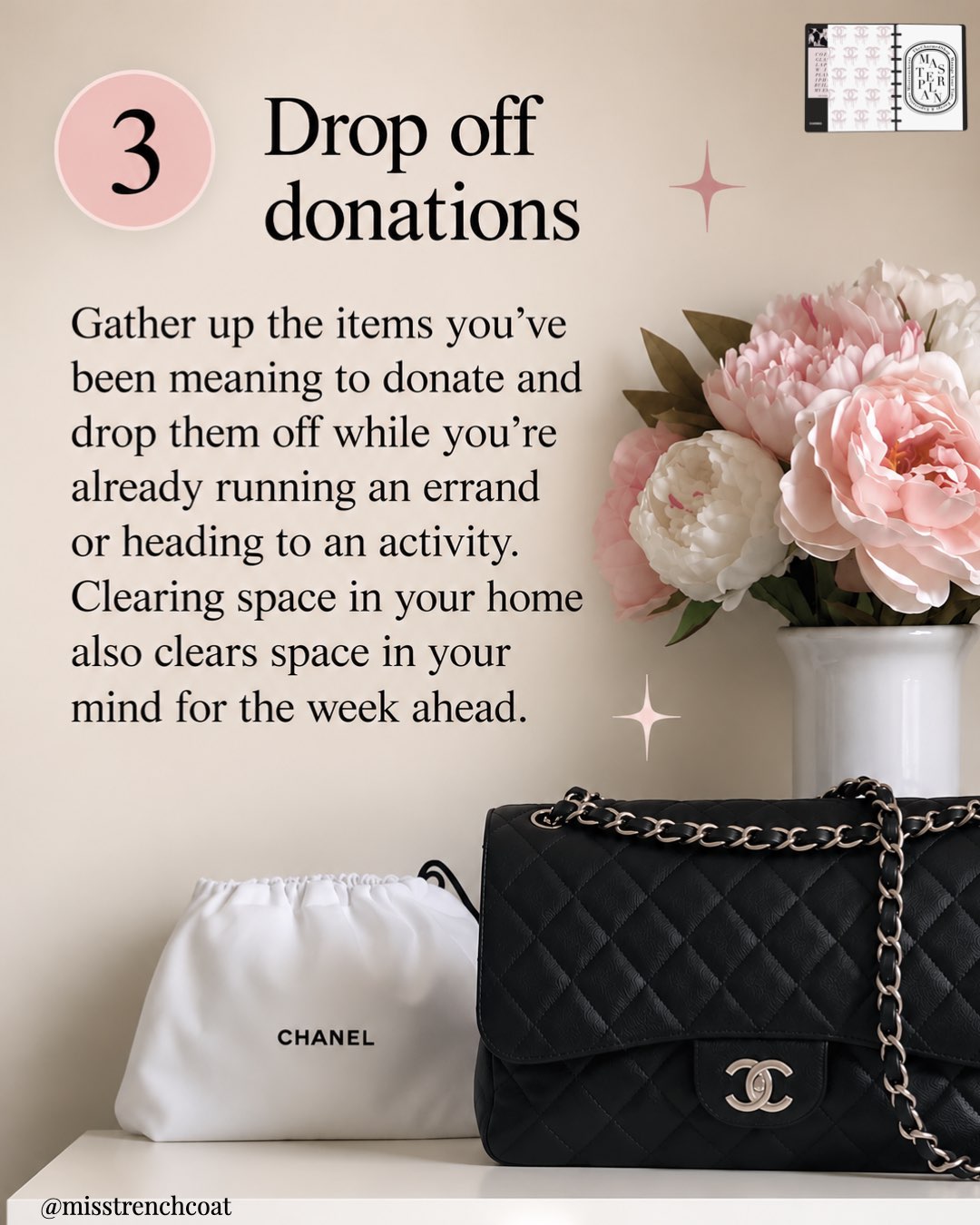
3. Drop Off Those Donations You’ve Been Meaning to Get Rid Of
Do you have a bag of clothing sitting in your closet waiting to be donated? Maybe there’s a box of household items in your garage, or a pile of things near the front door that you’ve been meaning to drop off for weeks.
This weekend, make it your mission to finally get those items out of your home.
The Soft Productivity approach is to combine this task with something you’re already planning to do. If you’re heading out for groceries, meeting a friend, or running another errand, see if you can stop at a donation center along your route.
This is one of those little tasks that can take up more mental space than the actual time required to complete it. Every time you see that bag or box, you’re reminded of something you haven’t finished. By taking care of it this weekend, you’re not only clearing physical clutter from your home but also eliminating another lingering responsibility from your mind.
4. Declutter One Small Space While Enjoying Your Downtime
Decluttering doesn’t have to mean spending an entire weekend reorganizing your home. In fact, I find that some of the most satisfying organizing projects are the ones that have a clearly defined beginning and end.
Choose one small, enclosed space that could use some attention, like a bathroom drawer, kitchen cabinet, nightstand, closet shelf, or storage bin. Then tackle it while you’re enjoying another activity.
Maybe you’re catching up on your favorite television show, listening to an audiobook, enjoying a podcast, or attending an online class that doesn’t require your full visual attention. You can use that time to sort through the space, remove anything you no longer need, and put everything back in a more functional arrangement.
The key is to keep the project small enough that you can finish it in one sitting. We’re not pulling apart the entire kitchen when we only have 30 minutes to spare!
Think about which spaces create the most friction in your everyday routine. If you’re constantly digging through a cluttered bathroom drawer to find your makeup, organizing that drawer could save you a few minutes every morning. If your kitchen cabinet is overflowing with mismatched containers, spending 20 minutes getting it organized could make preparing meals and packing leftovers easier all week.
A little organization now makes everyday activities simpler later.
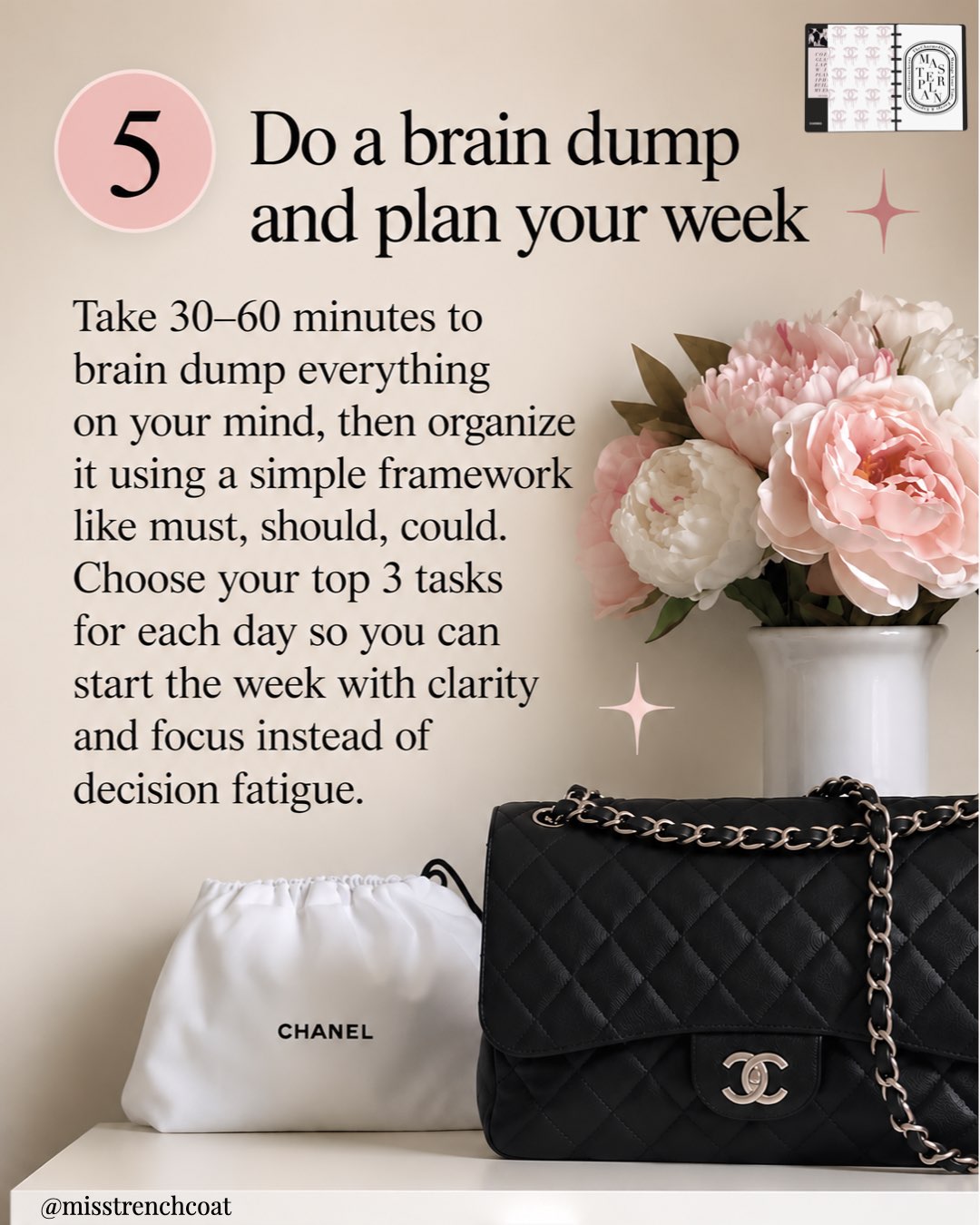
5. Do a Brain Dump and Plan Your Week
This might be my favorite activity on the list because it’s one of the most powerful ways to reduce overwhelm before the workweek even begins.
During one of your slower weekend mornings, pull out your planner, grab your favorite beverage, and spend 30–60 minutes getting everything out of your head and onto paper.
Start with a complete brain dump of everything that’s been occupying your mental space. Include tasks you need to complete, errands you need to run, appointments you need to schedule, projects you want to make progress on, and anything else you’ve been trying to remember.
Once you’ve captured everything, use my Must, Should, Could framework to prioritize your list:
Must: Tasks that are essential, time-sensitive, or connected to your most important responsibilities and goals.
Should: Tasks that would be beneficial to complete this week but aren’t necessarily urgent.
Could: Tasks that would be nice to accomplish if you have additional time and energy.
Next, review your calendar and identify your Daily Top 3 priorities for each workday. These are the three most important things you want to focus on completing that day.
This simple planning session allows you to start Monday morning knowing exactly what deserves your attention instead of spending valuable time trying to figure out where to begin.
And remember, your plan doesn’t need to account for every minute of your week. The goal is to create clarity and direction while leaving enough flexibility for real life.
6. Use Your Scrolling Time to Clear Your Digital Inbox and Lingering Admin Tasks
We all have those little moments throughout the day when we sit down, pick up our phones, and start scrolling without really thinking about it. Maybe you’re taking a break between activities, waiting for someone, or relaxing on the couch for a few minutes.
This weekend, try repurposing one of those moments to take care of a few small administrative tasks instead.
You could respond to emails you’ve been avoiding, reply to outstanding text messages, pay a bill, confirm an upcoming appointment, unsubscribe from unnecessary emails, or schedule something you’ve been meaning to put on your calendar.
These are often tasks that only take a few minutes individually, but when they accumulate, they create a surprising amount of mental clutter.
I’m not suggesting that every free moment needs to become productive. Rest and relaxation are important parts of Soft Productivity, too! But if you’re already reaching for your phone out of habit, consider whether spending 15–20 minutes clearing a few lingering responsibilities might make you feel better than another session of mindless scrolling.
You might be surprised by how much you can accomplish in the time you would have otherwise spent browsing social media.
7. Do a 30-Minute Reset of the High-Use Areas of Your Life
Here’s a weekend activity that can make a noticeable difference in how prepared you feel for the week ahead: a quick reset of the spaces and supplies you use most often.
Rather than waiting until Monday morning to discover that something needs to be cleaned, replenished, or reorganized, take care of several of these small maintenance tasks at once.
Put on some music, set a timer for 30 minutes, and move through your home resetting the areas that support your daily routines.
For example, your reset might include:
Workspace: Clear your desk, put away papers, empty the trash, and make sure your supplies are ready for Monday.
Handbag: Remove old receipts and unnecessary items, replenish your essentials, and make sure everything you need is packed.
Bathroom: Restock toiletries, organize your daily skincare products, and replace anything that’s running low.
Weekly pill organizer: Refill your medications or supplements according to their directions so they’re ready for the week.
Gym bag: Replace used workout clothes, pack fresh essentials, and prepare anything you’ll need for your next workout.
Bedside area: Tidy your nightstand, refresh your water glass, organize your reading materials, and prepare your space for a relaxing bedtime routine.
You don’t need to complete every possible reset each weekend. Instead, think about which areas of your life get the most use and would benefit from a little regular maintenance.
My favorite tip is to create a reusable Weekend Reset Checklist so you don’t have to remember everything from scratch each time. Once you’ve identified the areas that need regular attention, you can simply work through your list each weekend and enjoy the benefits of having everything ready when you need it.
Small Investments Today Create a More Productive Tomorrow
The real secret behind these seven activities isn’t that they’re particularly complicated or revolutionary. It’s that they help you approach the things you’re already doing with a little more intention.
When you prepare extra protein while cooking dinner, you’re saving yourself work later. When you plan your outfits while putting away laundry, you’re eliminating future decisions. When you organize a drawer while enjoying a podcast or handle administrative tasks during a scrolling break, you’re using time that already exists in your schedule to make your life easier.
That’s the power of Soft Productivity. It’s not about doing more work. It’s about creating simple systems that allow you to accomplish more with less unnecessary effort.
And you don’t need to complete all seven activities this weekend to experience the benefits. Start by choosing two or three that would make the biggest difference in your life right now. Invest a little time in your future self and notice how much easier certain parts of your week become.
Over time, these small intentional actions can become routines that help you feel more organized, prepared, and in control of your time.
Imagine If Your Entire Life Worked This Way…
Less stress. Fewer decisions. More time for the things that truly matter to you.
Imagine having simple, supportive systems in place not just for your weekend routine, but for your goals, your schedule, your home, your work, and your personal priorities.
Instead of constantly feeling like you’re playing catch-up, you could approach your days with more clarity, confidence, and intention.
That’s the kind of life I want to help you create inside the Charmed Life Master Mind.
The Charmed Life Master Mind is where we take the principles of intentional planning, personal organization, and Soft Productivity and put them into practice so you can create a life that feels as good as it looks.
If these seven weekend activities inspired you to think differently about how you use your time, imagine what could happen when you start applying these same principles throughout your entire life.
Learn the simple daily planning strategy that can help you overcome overwhelm, focus on what matters, and make consistent progress toward your goals.
Have you ever reached the end of a busy day, looked back at everything you accomplished, and somehow still felt like you hadn’t gotten anything important done? Maybe you spent hours answering emails, tidying your home, running errands, or handling all the little responsibilities that seem to demand your attention. You were certainly busy, and you may have even checked quite a few things off your to-do list, but the projects and goals that actually matter to you didn’t seem to move forward.
This is an incredibly common experience, especially for women who are juggling multiple responsibilities and trying to make progress in different areas of their lives. Between work, family, household management, personal commitments, and the goals we’re pursuing for ourselves, it’s easy to feel like there simply aren’t enough hours in the day to get everything done. And when we approach productivity with the expectation that we should be able to accomplish everything on our lists, we’re often setting ourselves up for unnecessary frustration.
One of the most important lessons I teach about productivity is that being busy and being productive are not necessarily the same thing. You can spend an entire day completing tasks without making meaningful progress toward your bigger goals. Likewise, you can accomplish just a handful of carefully selected priorities and end the day knowing that you’ve used your time effectively.
This is why I believe that well-planned women only need to prioritize three things each day. Not because we only have three responsibilities, or because everything else on our to-do lists is unimportant, but because learning to identify and focus on our most meaningful priorities is one of the simplest ways to create a more intentional and productive life.
Today, I want to introduce you to one of my favorite Soft Productivity strategies, the Daily Top 3 List, and explain how you can use it to take control of your schedule, overcome overwhelm, and start making consistent progress toward the goals that matter most to you.
What Is the Daily Top 3 List?
The Daily Top 3 List is a simple planning strategy that helps you identify the three most important tasks to prioritize each day. Instead of looking at your to-do list as one long collection of equally important responsibilities, you intentionally select three tasks that deserve your time, attention, and energy above everything else.
These three priorities become the foundation of your daily plan. They give you a clear sense of direction and help you make better decisions about how to spend your time, particularly when unexpected responsibilities, distractions, or interruptions arise throughout the day.
Now, I want to make an important distinction here. Your Daily Top 3 is not necessarily the only three things you’re going to accomplish. Most of us have far more than three responsibilities to manage on any given day, and there will always be routine tasks, appointments, errands, and other obligations that require our attention. The purpose of this strategy isn’t to limit what you can accomplish, but rather to make sure that your most important work doesn’t get lost among everything else.
Think of your Daily Top 3 as your personal definition of a successful day. If you complete these three priorities, you can feel confident that you’ve made meaningful progress, even if a few less important tasks remain unfinished. When practiced consistently, this approach can help you become more intentional with your time while building the kind of steady momentum that leads to meaningful results.
Why Your Traditional To-Do List Might Be Keeping You Stuck
One of the biggest challenges I see women struggle with when it comes to productivity is the tendency to treat every task on their to-do list as though it deserves equal attention. We write down everything we need or want to accomplish, and then we begin working through the list based on whatever feels easiest, most convenient, or most urgent in the moment.
The problem with this approach is that the easiest tasks aren’t always the most important, and the things that demand our attention aren’t necessarily the things that deserve it.
Imagine sitting down at your desk with the following to-do list:
Answer emails
Organize desktop files
Schedule a doctor’s appointment
Finish a presentation for tomorrow
Order new office supplies
Spend thirty minutes working on a business plan
Clean out your handbag
Review your monthly budget
Return a package
Plan meals for the week
Every task on this list serves some purpose, and each may eventually need to be completed. However, they don’t all carry the same level of importance or urgency. Finishing tomorrow’s presentation is clearly a time-sensitive responsibility, while working on your business plan may represent an important step toward a long-term goal. Reviewing your budget could provide valuable financial clarity, but organizing desktop files or ordering office supplies might not make a meaningful difference in your life today.
Without a clear system for prioritizing these responsibilities, it’s easy to spend your most productive hours completing smaller, more convenient tasks while postponing the work that actually matters. You may finish the day feeling exhausted from everything you’ve done, only to realize that your most important priorities are still waiting for you.
I think of this as the busywork trap, and it’s one of the reasons so many women feel like they’re constantly working without getting ahead. The Daily Top 3 helps you break out of this cycle by encouraging you to identify what truly deserves your attention before you begin filling your schedule with activity.
How to Choose Your Daily Top 3
Understanding the concept of the Daily Top 3 is relatively simple, but choosing your priorities can sometimes feel more challenging, particularly when you have a long list of responsibilities competing for your attention. After all, when everything on your to-do list feels important, how are you supposed to decide which three tasks deserve to come first?
To make this process easier, I recommend using three specific questions to guide your decision-making. Each question serves a different purpose, helping you balance meaningful accomplishments, immediate responsibilities, and progress toward your personal goals.
These three categories are designed to help you create a productive day that supports your whole life, rather than focusing exclusively on work or whatever happens to feel urgent in the moment.
Priority #1: Choose One Task That Would Make You Feel Productive If You Completed It Today
The first task on your Daily Top 3 should be something that would give you a genuine sense of accomplishment. When you’re deciding what belongs in this position, I want you to ask yourself a simple question: If I could only accomplish one meaningful thing today, what would make me feel like this day was productive?
For many women, the answer will be connected to a project, responsibility, or goal that requires focused effort. If you’re a business owner, this might mean recording a YouTube video, writing a promotional email, or finishing a product you’ve been developing. If you’re a student, it could be completing an important assignment or preparing for an upcoming exam. If you’re focused on managing your household, perhaps it’s finally organizing a space that’s been creating unnecessary stress.
The important distinction is that this task should represent meaningful progress rather than simply something that’s easy to check off your list. We all enjoy the satisfaction of crossing out completed tasks, but that feeling alone doesn’t necessarily indicate that we’ve spent our time productively.
One strategy I recommend is defining your priority as a specific outcome rather than a general activity. For example, instead of writing “work on my website,” you might write “finish updating the homepage copy and publish the changes.” Rather than writing “work on my business,” you could identify a specific accomplishment such as “write and schedule this week’s promotional email.”
When you clearly define what completion looks like, you eliminate much of the uncertainty that can lead to procrastination. You know exactly what needs to happen, and you have a concrete result to work toward.
Priority #2: Choose One Task That Will Cause a Problem or Delay If You Don’t Complete It Today
The second priority on your list should be a task that needs your attention because postponing it could create a problem, consequence, or unnecessary delay. These responsibilities may not always be the most exciting things on your schedule, but handling them proactively can make an enormous difference in how smoothly your life operates.
For example, this priority might involve paying a bill before its due date, submitting paperwork for an upcoming appointment, sending a client information they need to continue a project, or preparing materials for a meeting scheduled the following morning. These are the kinds of tasks that can become significantly more stressful when we put them off unnecessarily.
One of the greatest benefits of developing strong planning habits is that you begin preventing avoidable problems instead of constantly reacting to them. When you consistently address important responsibilities before they become emergencies, you create more stability in your schedule and reduce the amount of mental energy you spend worrying about unfinished obligations.
However, I also want to encourage you to distinguish between genuine urgency and the artificial urgency that often comes from external demands. Just because an email arrives in your inbox doesn’t mean it requires an immediate response, and someone else’s desire for your attention doesn’t automatically make their request your highest priority.
When you’re deciding whether a task truly belongs in this category, ask yourself what the actual consequence would be if you waited until tomorrow. If postponing the task would create a missed deadline, inconvenience someone who depends on you, or cause a preventable complication, it may deserve priority. If the only consequence is that the task remains on your list another day, it might not be as urgent as it initially seems.
Learning to make this distinction is an important part of becoming more intentional with your time. It allows you to take your responsibilities seriously without feeling obligated to respond immediately to every demand that comes your way.
Priority #3: Choose One Task You’ve Been Putting Off That Supports Your Goals or Self-Care
The third priority is one of my favorite parts of this strategy because it encourages you to make room for the things that are important to your personal growth and well-being. These are often the activities we know would improve our lives, but that we continually postpone because other responsibilities seem more pressing.
Maybe you’ve been meaning to establish a consistent exercise routine, spend more time reading, work on a creative project, or finally take the first step toward a personal goal. Perhaps you’ve been putting off scheduling an appointment, organizing your finances, or creating a routine that would help you feel more balanced throughout the week.
Whatever the case may be, I want you to ask yourself: What is one thing I’ve been putting off that would support my goals or help me take better care of myself?
I believe this question is especially important because so many women have developed the habit of putting their own goals and needs at the bottom of their priority lists. We tell ourselves that we’ll make time for these things once everything else is finished, but the reality is that there will always be another responsibility demanding our attention.
If you wait until your schedule is completely clear before investing in yourself, you may find that the opportunity rarely arrives.
That’s why I recommend intentionally including at least one task that supports your personal goals or well-being whenever your circumstances allow. It doesn’t need to be a major undertaking, either. Your priority might be taking a twenty-minute walk, spending fifteen minutes journaling, completing one lesson in an online course, or dedicating half an hour to a hobby you enjoy.
If you’ve been avoiding a particular goal because it feels overwhelming, try breaking it down into the smallest meaningful action you can take. Instead of writing “get healthy,” choose something specific like “take a twenty-minute walk after lunch.” Rather than writing “start my business,” your priority might be “outline three potential business ideas.”
The purpose isn’t to accomplish an entire goal in a single day. It’s to establish a pattern of consistently making room for the things that matter to you.
What a Daily Top 3 List Looks Like in Real Life
One of the things I love most about the Daily Top 3 strategy is its flexibility. Your priorities can change depending on your responsibilities, current goals, and the season of life you’re experiencing. You don’t need to follow the exact same routine every day, and you certainly don’t need to organize your life around someone else’s definition of productivity.
To help you see how this strategy works in practice, let’s look at a few examples.
Example 1: The Entrepreneur
Imagine you’re running your own business while managing the responsibilities of everyday life. Your to-do list is filled with content ideas, administrative work, customer requests, and long-term projects that you know are important for your business growth.
Your Daily Top 3 might look like this:
Productive Accomplishment: Record a YouTube video that promotes one of your offers.
Time-Sensitive Responsibility: Send a customer the information they need before tomorrow’s deadline.
Personal Goal or Self-Care: Spend thirty minutes reading a business development book you’ve been meaning to finish.
What makes this list effective is that it balances three different types of progress. You’re creating something that can support your business growth, fulfilling an important customer responsibility, and investing in your own development. Rather than spending the entire day reacting to messages or completing administrative busywork, you’re intentionally directing your time toward meaningful outcomes.
Example 2: The Working Professional
If you work a full-time job, your priorities may need to fit around meetings, deadlines, and responsibilities that are largely determined by your employer. This doesn’t mean you have no control over your productivity, but it does mean that being intentional about the time you can manage becomes especially important.
Your Daily Top 3 might look like this:
Productive Accomplishment: Finish the first draft of a report for an upcoming project.
Time-Sensitive Responsibility: Submit an expense reimbursement before the deadline.
Personal Goal or Self-Care: Attend an evening yoga class.
In this example, you’ve made progress on an important professional project, handled a responsibility that could create complications if delayed, and protected time for your personal well-being. Even if your day includes additional meetings and routine work, these three accomplishments provide a meaningful foundation for success.
Example 3: The Woman Focused on Her Personal Life
Productivity doesn’t always have to revolve around professional accomplishments. Depending on your current circumstances, you may be focusing more of your energy on your home, family, health, or personal development. The Daily Top 3 works just as well in these areas because its purpose is to help you make progress toward whatever matters most in your life.
Your priorities might look like this:
Productive Accomplishment: Declutter and reorganize the kitchen pantry.
Time-Sensitive Responsibility: Complete the paperwork needed for an upcoming appointment.
Personal Goal or Self-Care: Spend thirty minutes working on a creative hobby.
These tasks may seem relatively simple, but together they represent progress in several meaningful areas of life. You’ve improved your environment, taken care of an important responsibility, and made time for something that brings you personal fulfillment.
That’s the beauty of this approach. Your Daily Top 3 should reflect your life, your goals, and your priorities rather than an arbitrary standard of what productivity is supposed to look like.
Five Strategies to Make Your Daily Top 3 More Effective
Once you’ve identified your three priorities, the next step is making sure you actually follow through on them. Choosing the right tasks is an important starting point, but the real value of this strategy comes from consistently turning your intentions into action.
Over the years, I’ve found that a few simple planning habits can make a significant difference in how effectively we manage our priorities. Here are five strategies I recommend incorporating into your routine.
1. Choose Your Priorities Before the Day Gets Away From You
I recommend identifying your Daily Top 3 either during your evening planning routine or first thing in the morning, before you become distracted by the demands of the day. When you begin your morning without a clear plan, it’s easy to slip into reactive mode, checking your phone, answering messages, or handling whatever responsibility happens to present itself first.
Before you know it, an hour or two has passed, and you haven’t made any progress on the things you actually wanted to accomplish. By deciding on your priorities ahead of time, you give yourself a clear starting point and eliminate the need to continually figure out what you should be doing next.
Personally, I love the idea of reviewing your schedule and to-do list the evening before so you can begin the next morning with a sense of direction. However, if morning planning works better for your routine, that’s perfectly fine. The important thing is to make intentional decisions about your priorities before the day begins making those decisions for you.
2. Complete Your Priorities as Early as Reasonably Possible
One of the simplest ways to improve your productivity is to give your most important tasks attention before your day becomes crowded with distractions. This doesn’t mean that everyone needs to wake up at five in the morning or complete all their responsibilities before lunch. It simply means recognizing that important tasks are less likely to get postponed when you intentionally make room for them earlier in your schedule.
For example, if you have a project that requires concentration and creative thinking, you might find it helpful to work on it before opening your email or checking social media. If your priority involves making an important phone call, you’ll want to schedule that task during the appropriate business hours. And if you’re trying to establish a consistent exercise routine, consider choosing a time when your energy and motivation are usually strongest.
The key is to work with your natural rhythms and existing responsibilities rather than forcing yourself into a routine that doesn’t fit your life.
3. Give Each Priority a Place in Your Schedule
One of the most common planning mistakes I see is identifying important tasks without deciding when they’re actually going to get done. We write down our priorities with the best intentions, but then we allow the day to unfold without creating any dedicated time to work on them.
This is where time blocking can become incredibly helpful. By assigning each priority a specific place in your schedule, you’re making a practical commitment to follow through.
For example, your schedule might include:
9:00–10:30 AM: Write and schedule a promotional email.
Of course, your schedule doesn’t need to be rigid, and unexpected responsibilities may require you to make adjustments. The purpose of time blocking isn’t to control every minute of your day, but to make sure the things you’ve identified as important actually have space in your routine.
When you know when you’re planning to work on a task, you’re much less likely to spend the day wondering when you’ll finally get around to it.
4. Be Realistic About Your Time and Energy
I want to emphasize that your Daily Top 3 should be realistic for the day you actually have ahead of you. If your schedule is already filled with meetings, appointments, or family responsibilities, it probably doesn’t make sense to choose three enormous projects that each require several hours of uninterrupted work.
Instead, consider how much time and energy you realistically have available, and adjust the scope of your priorities accordingly. If you’re working on a website redesign, perhaps today’s task is simply outlining the new homepage. If you’re organizing your home, maybe you focus on one drawer or cabinet instead of attempting to declutter an entire room.
This is an important part of my Soft Productivity philosophy. I don’t believe productivity should require us to ignore our physical needs, sacrifice our peace, or constantly push ourselves beyond our capacity. Some days you’ll have the energy and opportunity to accomplish three substantial tasks, while other days three smaller accomplishments will represent meaningful progress.
Both can be successful days when you’re making intentional decisions about how to use the resources available to you.
5. Review Your Progress and Adjust as Needed
At the end of the day, I encourage you to take a few minutes to review your Daily Top 3 and reflect on how things went. This doesn’t need to become an elaborate journaling exercise or another complicated task on your schedule. A simple five-minute review can provide valuable insight into your planning habits.
Consider asking yourself the following questions:
Did I complete my three priorities?
What helped me make progress today?
What distractions or obstacles affected my schedule?
Did I underestimate how much time any of my tasks would require?
What adjustments would make tomorrow’s plan more effective?
Over time, this reflection can help you identify patterns in your productivity. You may discover that you’re consistently more focused during certain hours, that particular tasks require more time than you anticipate, or that some responsibilities are repeatedly interrupting your plans.
Rather than viewing these observations as evidence that you’re doing something wrong, use them as information that can help you create more effective routines.
What If Everything on Your To-Do List Feels Important?
One question that naturally comes up when discussing the Daily Top 3 is what to do when you have more than three responsibilities that genuinely seem important. After all, there are certainly days when multiple deadlines, appointments, and obligations require our attention, and it isn’t always possible to reduce everything to three tasks.
In these situations, I recommend beginning with a simple prioritization exercise that separates your responsibilities into three categories.
Must Do: Tasks with genuine deadlines, important consequences, or responsibilities that cannot reasonably be postponed.
Should Do: Tasks that would create meaningful progress but offer some flexibility in when they’re completed.
Could Do: Tasks that would be useful or enjoyable to complete but aren’t essential to today’s success.
Once you’ve organized your list, begin by identifying any responsibilities in the Must Do category that absolutely need to be completed today. These are the tasks you’ll need to account for when planning your schedule, regardless of whether they fit neatly into your Daily Top 3.
Next, review your Should Do category and consider which tasks would create the most meaningful progress toward your goals. This is often where you’ll find the work that deserves focused attention but can easily get pushed aside when you’re busy managing immediate responsibilities.
Finally, treat your Could Do category as a collection of optional activities that you can work on if you have additional time and energy available.
It’s important to remember that the Daily Top 3 is a prioritization strategy, not a rule that allows you to ignore other genuine obligations. If you have five unavoidable deadlines today, you’ll need to plan for all five. However, you can still identify which three deserve your earliest or most focused attention.
And if you consistently find yourself facing more urgent responsibilities than you can realistically manage, that may be a sign that you need to reevaluate your commitments, routines, or planning systems. Sometimes the solution to feeling overwhelmed isn’t simply becoming more efficient. It’s recognizing that your schedule needs to better reflect your actual capacity.
What If You Don’t Finish Your Daily Top 3?
Even with the best planning system in place, there will be days when you don’t accomplish everything you intended. Unexpected responsibilities arise, projects take longer than anticipated, and sometimes your energy simply doesn’t match the expectations you had when you created your schedule.
When this happens, I don’t want you to automatically interpret an unfinished priority as a personal failure. Instead, I encourage you to approach the situation with curiosity and use it as an opportunity to improve your planning.
Start by considering why the task wasn’t completed. Was it too large for the time you had available? Did something more important come up? Were you distracted by less meaningful activities, or were you avoiding the task because it felt uncomfortable or overwhelming?
Understanding the reason can help you determine the best next step. Perhaps the task needs to be broken into smaller actions, assigned a dedicated time block, or delegated to someone else. In some cases, you may even realize that the task wasn’t as important as you originally believed.
One habit I recommend avoiding is automatically transferring every unfinished task to the following day’s to-do list. While this may seem like the easiest solution, it can quickly create a cycle where the same responsibilities get carried forward day after day without any meaningful progress.
Instead, take a moment to reevaluate whether the task still deserves priority and what needs to change to help you complete it successfully.
Remember, the purpose of planning isn’t to create a perfect record of completed tasks. It’s to help you become more intentional, effective, and confident in how you manage your time.
How Small Daily Priorities Lead to Big Results
One of the reasons I’m such a strong advocate for the Daily Top 3 is that it helps connect our everyday actions to the bigger goals and dreams we have for our lives. When we think about achieving a major goal, it’s easy to become overwhelmed by everything that needs to happen between where we are today and where we want to be.
Whether you’re trying to start a business, improve your health, organize your home, write a book, or develop a new skill, there may be dozens of individual steps involved in achieving the outcome you want. Looking at the entire process can make the goal feel intimidating, especially when you’re already managing a full schedule.
But here’s something I want you to remember: You don’t need to accomplish an entire goal in one day. You simply need to identify the next meaningful action and make consistent progress.
Imagine, for example, that one of your goals is to write a book. Instead of waiting until you have an entire weekend available to write, you decide to make a thirty-minute writing session one of your daily priorities four days per week.
If you write an average of 400 words during each session, that’s approximately 1,600 words per week. Over ten weeks, you could have 16,000 words drafted, all from relatively small, manageable writing sessions that fit into your existing routine.
Or perhaps your goal is to create a more organized home. Rather than waiting for the perfect opportunity to tackle an enormous decluttering project, you decide to spend twenty minutes organizing one small area of your home five days per week.
That’s 100 minutes of intentional organizing each week, which adds up to several hours of progress over the course of a month. You may not notice a dramatic transformation after the first session, but as you continue taking action, the results begin to accumulate.
These examples illustrate one of the most important principles of intentional productivity: meaningful change is often the result of small actions repeated consistently over time.
You don’t always need dramatic changes, enormous amounts of free time, or extraordinary bursts of motivation to make progress. You need a clear understanding of what matters, a realistic plan for taking action, and the willingness to keep showing up.
The Daily Top 3 helps you practice exactly that.
Try the Daily Top 3 Challenge for the Next Seven Days
If you’re ready to experience the benefits of this strategy for yourself, I want to challenge you to use the Daily Top 3 for the next seven days. You don’t need any special tools or complicated planning systems to get started. All you need is your current to-do list, a place to write down your priorities, and a few minutes each day to make intentional decisions about how you’ll spend your time.
Here’s how I recommend approaching the challenge.
Step 1: Create Your Master To-Do List
Begin by writing down everything that’s currently competing for your attention. Include work responsibilities, household tasks, errands, personal projects, long-term goals, and anything else you’ve been meaning to accomplish.
At this stage, don’t worry about organizing everything perfectly. The purpose is simply to get those responsibilities out of your head and into one place where you can review them more objectively.
Step 2: Identify Your Three Daily Priorities
Each morning, or the evening before, review your master list and answer the following questions:
What one task would make me feel productive if I completed it today?
What one task could cause a problem or delay if I don’t complete it today?
What one task have I been putting off that supports my goals or self-care?
Use your answers to create your Daily Top 3, making sure each priority represents a specific, actionable outcome.
Step 3: Schedule Time to Complete Your Priorities
Once you’ve selected your three tasks, review your schedule and identify when you realistically have time to work on each one. Consider your existing commitments, natural energy levels, and the amount of time each task will require.
Remember to leave some flexibility in your schedule for unexpected responsibilities. A realistic plan is much more valuable than an ambitious schedule you have little chance of following.
Step 4: Take Intentional Action
As you move through your day, use your Daily Top 3 to guide your decisions about where to focus your attention. Whenever possible, work on your most important priorities before getting pulled into less meaningful activities.
You may still need to handle other responsibilities throughout the day, but having a clear set of priorities makes it easier to return your attention to what matters.
Step 5: Reflect on Your Progress
At the end of each day, take a few minutes to review your accomplishments and consider what you learned about your planning habits. Notice which strategies helped you follow through and where you may need to make adjustments.
After seven days, reflect on the overall experience. Do you feel more confident about how you’re using your time? Are you making progress toward goals that previously seemed difficult to prioritize? Have you noticed any changes in your stress levels or sense of accomplishment?
Even if your week wasn’t perfect, you may be surprised by how much clarity this simple exercise can create.
Imagine What You Could Achieve With the Right Planning Systems and Support
If you’ve made it this far, I hope you’re beginning to recognize just how much of a difference one simple productivity strategy can make in the way you approach your day. Learning to identify your three most important priorities may seem like a small adjustment, but it can completely change the way you think about your responsibilities and how you define a successful day.
Now, I want you to imagine something.
If this one strategy helped you gain clarity about how to prioritize your daily to-do list, imagine how much more you could accomplish with an entire library of coaching, lessons, strategies, and resources designed to help you create your most productive, organized, and intentional life.
That’s exactly why I created the Charmed Life Master Mind!
The Charmed Life Master Mind is designed to help women move beyond simply collecting productivity tips and begin creating meaningful, lasting changes in the way they plan, organize, and manage their lives. Through my coaching, guidance, and resources, I help you develop the skills and systems that make it easier to follow through on your plans and make consistent progress toward your goals.
Inside the Master Mind, you’ll find support to help you:
Set meaningful goals and create actionable plans to achieve them.
Develop productive routines and systems that simplify your everyday life.
Overcome procrastination, overwhelm, and the habits that keep you feeling stuck.
Learn how to prioritize your time and energy around what matters most.
Create a more organized, intentional, and fulfilling lifestyle without sacrificing your peace in the process.
After years of teaching women how to plan and achieve their goals, one thing I know for certain is that you don’t necessarily need more hours in the day to create meaningful change in your life. What you need are the right strategies, supportive systems, and confidence to follow through on the plans you’ve made.
And the wonderful thing is that you don’t have to figure all of that out on your own.
If you’re ready to move beyond feeling overwhelmed by your responsibilities and start becoming the woman who confidently follows through on her plans, achieves her goals, and creates a life she absolutely loves, I would be delighted to support you inside the Charmed Life Master Mind.
✨ Join the Charmed Life Master Mind Today!
Your next chapter of intentional productivity can begin with one decision, and I’d love to help you make it a meaningful one.
Final Thoughts: Productivity Is About Progress, Not Perfection
At the end of the day, the purpose of planning isn’t to fill every available moment with more work or to measure your success by how many tasks you can check off a list. It’s to help you make intentional decisions about how you spend your time, what deserves your attention, and how you can create meaningful progress toward the life you want to live.
The Daily Top 3 is such a powerful strategy because it encourages you to look beyond the endless stream of everyday responsibilities and identify what actually matters. It gives you a simple framework for balancing productive accomplishments, important obligations, and personal goals, while helping you develop the confidence to make better decisions about your time.
And perhaps most importantly, it reminds you that you don’t need to accomplish everything in order to have a successful day. You simply need to focus on the things that will make the greatest difference.
So the next time you sit down with an overwhelming to-do list, instead of wondering how you’re possibly going to get everything done, take a moment to identify your three most meaningful priorities. Give those tasks the time and attention they deserve, and allow yourself to recognize the progress you’re making along the way.
Because well-planned women don’t need to do everything. They need to know what matters most, create a plan to accomplish it, and trust that their consistent efforts will lead to meaningful results.
If you’ve been following my content recently, you’ve probably heard me talking about the concept of Soft Productivity—this idea that being productive doesn’t have to mean constantly doing more, working harder, or filling every available moment with another task.
And I think this concept is especially important when we apply it to business.
Because there is a very common misconception in business that growth requires you to constantly do more.
If you want more visibility, you need to create more content. If you want more leads, you need to spend more time on social media. If you want more sales, you need to launch more often, send more emails, create more offers, and generally spend more hours working on your business.
But what if the real problem isn’t that you aren’t doing enough?
What if your business simply requires too much active effort from you in order to produce results?
That’s what I want to talk about today, because one of the most important ways that I think we can apply Soft Productivity to our businesses is by creating systems.
Soft Productivity isn’t about lowering your ambitions or caring less about your results. It’s about being more intentional with your time, energy, and attention so that the work you do produces a greater return.
Instead of measuring productivity by how much you accomplish or how many hours you work, you start looking for ways to simplify your workload, prioritize the activities that actually move your business forward, and create systems that reduce the amount of effort required to generate consistent results.
And a good business system gives you a repeatable process for accomplishing an important objective.
Rather than continually asking yourself what you should do next, reinventing your process every time you need to accomplish something, or relying on motivation to keep everything moving, you create a structure that makes important work easier to execute consistently.
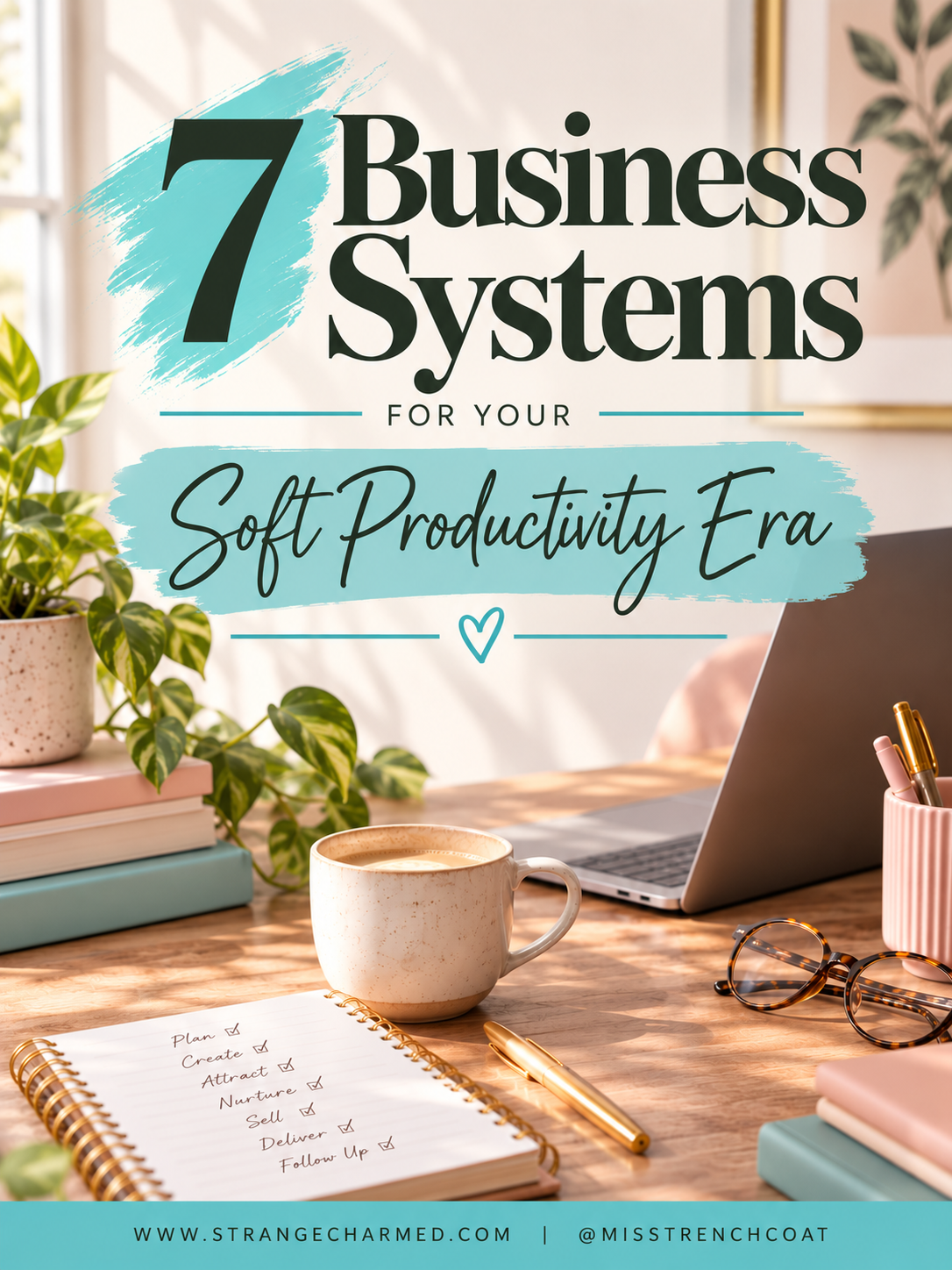
So, in this video, I want to walk you through seven business systems that I think every entrepreneur should consider building as they enter their Soft Productivity Era.
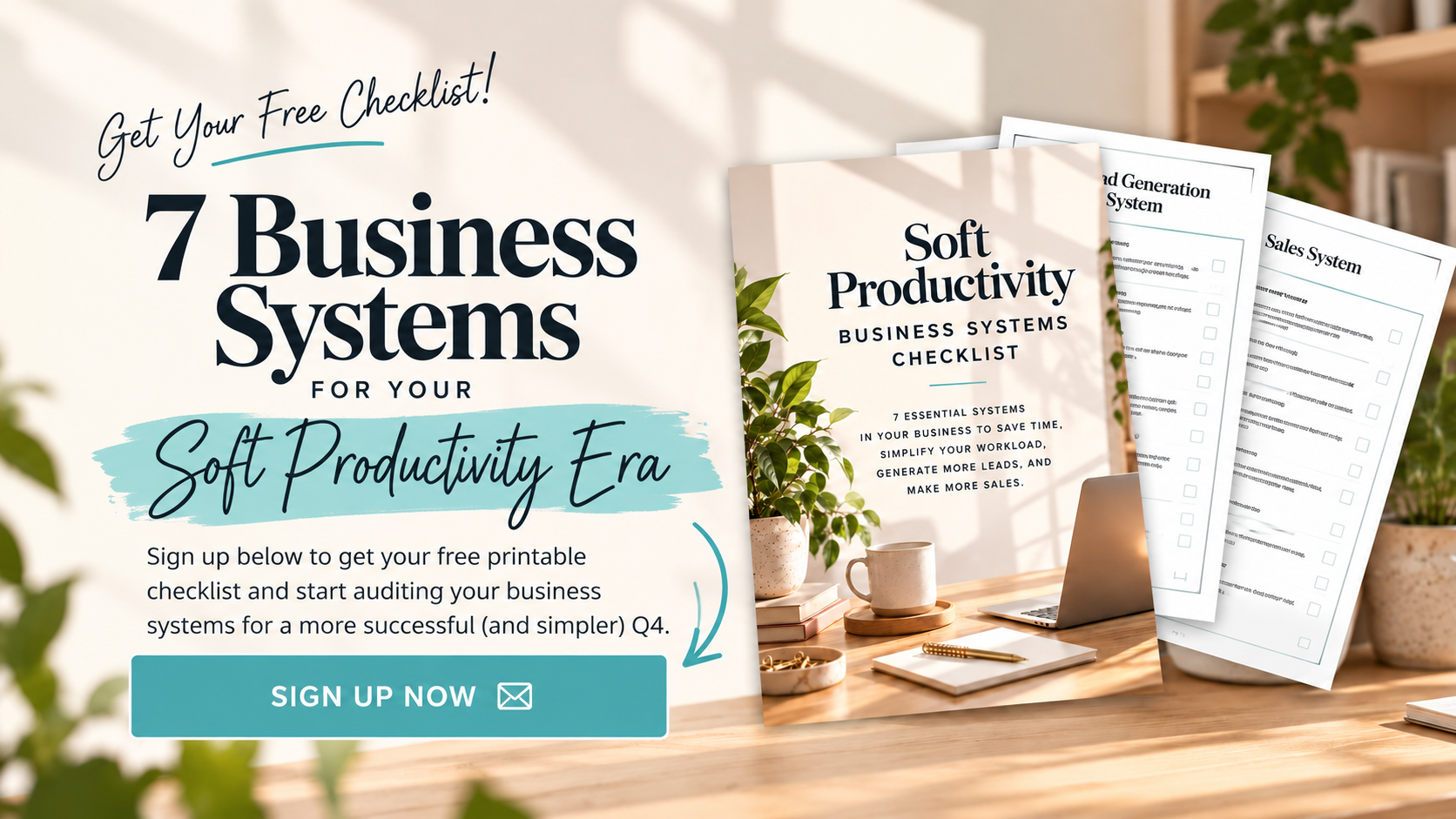
And make sure you stay with me until the end because I also have a free Soft Productivity Business Systems Checklistthat you can download to audit these seven systems in your own business and figure out which one you should focus on improving next.
Let’s get into the seven systems.
System #1: A Functional Planning System
The first system you need is a Functional Planning System.
Every business needs a reliable way to determine what actually deserves your time and attention.
Without a planning system, it’s incredibly easy to spend your working hours reacting to whatever feels most urgent in the moment.
You answer emails. You make some graphics. You tweak something on your website. You check social media. You organize some files. You complete a bunch of little tasks.
And then you get to the end of the day and think, What did I actually accomplish?
You were busy all day, but did you actually move your business forward?
A functional planning system helps you capture everything that needs your attention, identify your most important objectives, break those objectives into actionable projects and tasks, and then intentionally allocate your available time toward the work that matters most.
And this becomes especially important when your working hours are limited.
If you only have two hours to work on your business today, Soft Productivity isn’t about asking, How many tasks can I squeeze into those two hours?
It’s about asking, What are the highest-impact things I could accomplish with those two hours?
Because you don’t necessarily need more time.
You need to make sure that the work you’re giving your time to actually deserves it.
System #2: A Content Management System
The second system is a Content Management System.
Content is one of the most valuable tools you have for attracting new people to your business, demonstrating your expertise, building trust, and creating demand for your offers.
But content can also become one of the biggest drains on your time if you don’t have a system for managing it.
Without a content management system, you’re constantly starting from zero.
You open Instagram and wonder what you should post.
You sit down to write an email and have no idea what to say.
You realize another week has passed and you still haven’t published that blog post or video you intended to create.
And that creates a tremendous amount of unnecessary mental load.
Instead, you want a system that gives your ideas somewhere to live and provides a repeatable process for turning those ideas into published content.
That might include a place where you capture ideas as they occur to you, a content calendar that helps you determine what you’re going to publish, a workflow for actually creating the content, and a library where you keep track of everything you’ve already produced.
And notice that the goal here isn’t necessarily to create more content.
A good content management system may actually help you create less content because the content you do create becomes much more intentional.
You want your content connected to your larger business objectives and designed to attract the kind of people who are most likely to benefit from the offers you sell.
System #3: A Content Repurposing System
The third system is a Content Repurposing System.
And this relates to one of my favorite Soft Productivity principles for business:
Maximize before you make.
Before you assume you need to create something new, look at what you’ve already created.
If you spent hours creating a really valuable blog post, that idea doesn’t need to live and die as one blog post.
That blog post could become a YouTube video.
It could become several social media posts.
It could become an email to your list.
It could become Pinterest content.
It might even become the foundation for a future lead magnet or training.
And the same thing works in reverse. A successful video could become a blog post, an email, several short-form videos, or a series of social posts.
I’ve taught this strategy in my business content for years because creating something once and finding multiple ways to use it is one of the easiest ways to increase the return on the time you’ve already invested.
You do not need to continually feed a content machine that demands something completely new from you every single day.
Instead, you want to build a library of ideas and assets that can continue supporting your marketing.
So your content repurposing system should help you regularly look at what you’ve already created, identify what performed well, and find new ways to present those ideas to your audience.
Because just because you’ve said something before doesn’t mean everyone in your audience has seen it.
And even the people who have seen it may need to encounter the idea several times before they’re ready to act on it.
System #4: A Lead Generation System
The fourth system is your Lead Generation System.
And this is where I see a major bottleneck for a lot of small business owners.
Maybe you’re already creating content.
Maybe you have followers.
Maybe people are visiting your website, reading your blog posts, watching your videos, finding you through Pinterest or interacting with your social media content.
But then what?
What happens after someone discovers you?
Because if the answer is essentially nothing, you may be putting a tremendous amount of time and energy into attracting attention without having a reliable way to turn that attention into an ongoing relationship.
Someone can find an incredibly helpful blog post through Google, read the entire thing, close the browser tab and never come back.
Someone can watch one of your videos, think you’re fantastic, and then never have your content served to them again.
Someone can follow you on social media, but you have absolutely no control over whether the algorithm continues showing that person your content.
This is why you need a lead generation system.
Instead of hoping someone remembers you, you give them a clear next step.
Maybe that’s a checklist, workbook, template, free training, or another lead magnet that relates directly to the problem that brought them to your content in the first place.
And now, instead of that person simply consuming a piece of content and disappearing, they have a reason to join your email list and continue the relationship.
This is a really important Soft Productivity system because it allows the work you’ve already done to create a longer-term result.
Your content stops being something that simply generates views or likes.
It becomes an asset that can generate leads.
And ideally, your best evergreen content can continue doing that days, months, or even years after you originally created it.
System #5: An Email Nurture System
But generating the lead is only the beginning, which brings us to system number five: your Email Nurture System.
One of the biggest mistakes I see business owners make is putting a tremendous amount of effort into getting people onto their email list and then having absolutely no plan for what happens afterward.
Someone downloads your freebie.
They get the delivery email.
And then… nothing.
Maybe they hear from you again three weeks later when you suddenly have something you want to sell.
And by then, they might barely remember who you are or why they joined your list.
So now you’re essentially asking someone to go from, I downloaded something free from you once, to, Sure, I’m ready to give you money.
There’s an important part of the relationship missing in between.
That’s what your email nurture system is designed to address.
When someone joins your list, you can create an automated sequence that welcomes them into your world, helps them get value from the resource they requested, provides additional education around the problem they’re trying to solve, introduces your philosophy and expertise, and eventually helps them understand what their next step might be.
And the beautiful thing about this is that you create that sequence once.
Every new person who joins your list can receive that thoughtful introduction to your business without you personally recreating that experience every single time.
That is a perfect example of Soft Productivity.
You do the work once, create something valuable, and then build a system that allows that work to continue producing value.
System #6: A Sales System
The sixth system is probably one of the most important: your Sales System.
Here’s a question I want you to think about:
What causes sales to happen in your business right now?
Because if your answer is essentially, Sales happen when I actively remember to sell something, then you don’t really have a sales system.
You have a recurring task.
And this is where a lot of entrepreneurs accidentally create far more work for themselves than necessary.
They create content for a while.
Then they realize they need to make some money.
So suddenly they need to figure out what they’re going to promote.
They create a bunch of sales posts.
They send several emails.
Maybe they run a launch or promotion.
Hopefully they make some sales.
Then the promotion ends, they stop selling, and they go back to regular content until the next time they need revenue.
And then they start the entire process again.
Not only is that exhausting, but it can also make selling feel awkward because there isn’t always a natural connection between the content your audience has been consuming and the offer you suddenly want them to buy.
A Soft Productivity approach to sales asks a different question:
How can I create a natural, repeatable path that helps the right person move from discovering my business to becoming a customer?
And that path does not have to be complicated.
Someone discovers a piece of useful content because it addresses a problem they’re experiencing.
That content introduces them to a relevant free resource.
They join your email list to receive the resource.
An email sequence provides additional education, builds trust, and helps them better understand the problem.
And eventually, you introduce a paid offer that helps them solve that problem more completely.
So you have:
Content. Lead magnet. Email. Offer.
That is the foundation of a simple sales funnel.
And I want to emphasize the word simple, because I think people sometimes hear the term “sales funnel” and imagine some massive, complicated marketing machine.
It doesn’t have to be that.
At its core, a sales funnel is simply an intentional path that connects the work you’re already doing.
Your content attracts the right people.
Your lead magnet turns some of those people into leads.
Your emails build the relationship.
And your offer gives them an opportunity to take the next step with you.
That means your sales no longer have to depend entirely on constant posting, repeated launches, or you manually remembering to promote your products every day.
You can still launch. You can still run promotions. You can absolutely still actively sell.
But those things don’t have to do all of the heavy lifting.
System #7: A Customer Follow-Up System
And finally, system number seven is a Customer Follow-Up System.
Your existing customers are one of the most valuable resources in your business, but a lot of entrepreneurs spend significantly more time thinking about how to find new customers than they do thinking about the people who have already purchased from them.
So ask yourself:
What happens after somebody buys?
Do they receive guidance that helps them actually use what they purchased?
Do you check in with them after an appropriate amount of time?
Do you ask for feedback?
Do you give happy customers an easy way to provide a testimonial?
And is there another product or service you offer that could logically help them with their next step?
A simple customer follow-up system can help you strengthen those relationships while also creating opportunities for additional sales, referrals, reviews, and testimonials.
And again, the Soft Productivity approach is to create a repeatable system rather than relying on yourself to remember every individual action.
Enter Your Soft Productivity Business Era
So those are the seven systems I want you to think about:
Your Functional Planning System.
Your Content Management System.
Your Content Repurposing System.
Your Lead Generation System.
Your Email Nurture System.
Your Sales System.
And your Customer Follow-Up System.
Now, I don’t want you to finish this video thinking, Great. Alexis just gave me seven enormous projects I need to complete.
Please don’t do that.
That would be the exact opposite of what we’re talking about.
You do not need seven perfect systems by next week.
Instead, I want you to ask yourself:
Which part of my business currently requires more of my time and attention than it should?
Where are you repeatedly doing the same work?
Where does everything stop moving whenever you stop actively working?
And where would creating a little more structure now save you a significant amount of time and energy later?
Maybe you constantly struggle to decide what to work on, so you need to strengthen your planning system.
Maybe content creation is taking over your life, so you need better content management and repurposing systems.
But if you’re already creating content and it isn’t consistently generating leads, if people are joining your email list but there isn’t a clear journey waiting for them afterward, or if sales tend to happen only when you’re actively launching and promoting, I would pay particularly close attention to your lead generation, email nurture, and sales systems.
Because those three systems work together.
They allow you to take the attention you’re already generating and create a path that can turn some of those people into leads, nurture those leads over time, and eventually introduce them to an offer that can help them.
And that can remove an enormous amount of pressure from the way you market and sell your business.
Download the Soft Productivity Business Systems Checklist
Now, if you want some help figuring out which of these systems you should focus on next, I created a free Soft Productivity Business Systems Checklist to go along with this video.
It’s not just a list of the seven systems.
I’ve broken each one down into specific elements so you can actually audit your business, see what you already have in place, identify where the gaps are, and determine which system would create the greatest improvement for you right now.
And remember, the goal isn’t to check every box immediately.
The goal is to find your next system.
So use the link below to download your free copy of the Soft Productivity Business Systems Checklist, go through the audit, and use it to identify the next system you can simplify, strengthen, or put to work in your business.
Because Soft Productivity isn’t about wanting less from your business.
It’s about building your business in a way that doesn’t require more and more from you in order to grow.
Most people think a planner is just a place to write appointments and to-do lists.
But the truth is, the right planner can completely change the way you think, work, prioritize, and move through your life.
The Charmed Life Master Planner was designed to be much more than a calendar. It was built around proven productivity principles, behavioral psychology, strategic planning systems, and routines that help you become more focused, intentional, and productive naturally over time.
In other words, this planner doesn’t just help you organize your life — it actually teaches you how to function differently.
Every section was created with a purpose. Every page is designed to help reduce overwhelm, improve follow-through, support consistency, and make space for what matters most.
Here are 20 productivity strategies secretly built into the Charmed Life Master Planner and how they help you become more productive simply by using it consistently.
1. The Encoding Effect
Research has shown that writing things down by hand improves memory, clarity, and follow-through. In fact, studies have found that people who write down their goals are significantly more likely to achieve them.
This is one of the reasons the Charmed Life Master Planner emphasizes brain dumping, goal setting, written planning routines, and daily task management. Writing things down forces you to slow down, process your thoughts more intentionally, and become more aware of your priorities.
Your planner becomes a second brain instead of forcing your mind to hold onto everything all at once.
2. The Zeigarnik Effect
The Zeigarnik Effect explains why unfinished tasks create mental tension. Your brain keeps trying to remind you about things that haven’t been completed, which is one of the reasons overwhelm and mental clutter feel so exhausting.
The brain dump and capture system inside the Charmed Life Master Planner helps reduce this cognitive load by giving every task, idea, reminder, and obligation a place to live outside your head.
One of the most productive things you can do is stop trying to remember everything.
3. Prioritization Through the Eisenhower Matrix
Being busy and being productive are not the same thing.
One of the biggest productivity mistakes people make is treating every task like it carries the same level of importance. The Charmed Life Master Planner includes prioritization strategies inspired by the Eisenhower Matrix to help you identify what is actually urgent, important, neither, or both.
This helps you stop reacting to everything immediately and start making more intentional decisions about where your time and energy go.
4. The Pareto Principle (80/20 Rule)
The 80/20 Rule states that roughly 20% of your efforts create 80% of your results.
Most people waste enormous amounts of time on low-impact tasks because they never stop to identify what truly moves the needle.
The Daily Top 3 system built into the Charmed Life Master Planner helps train your brain to focus on the tasks that matter most instead of trying to do everything at once. Over time, this creates more momentum, clarity, and meaningful progress with less burnout.
5. Parkinson’s Law
Parkinson’s Law states that work expands to fill the time available for its completion.
Without structure, tasks tend to drag on much longer than necessary. This is why the planner includes scheduling systems, routines, time blocking, and intentional planning frameworks that help create healthy boundaries around your time.
One of the most effective productivity strategies is assigning tasks to specific periods of time instead of hoping you’ll “find time” later.
The Charmed Life Master Planner includes ideal daily routines, weekly schedules, and planning frameworks that encourage intentional time allocation. This helps reduce procrastination while improving focus and follow-through.
If something matters to you, it deserves space on your calendar.
7. Cognitive Load Reduction
Your brain was not designed to store endless lists of tasks, appointments, reminders, and obligations.
The more mental clutter you carry, the harder it becomes to focus, make decisions, and think creatively.
The planner’s structured systems help reduce cognitive overload by organizing your thoughts, projects, routines, and priorities into one centralized place. This frees up mental bandwidth so you can focus on execution instead of constant mental management.
8. Decision Fatigue Reduction
Every decision you make throughout the day uses mental energy.
What to wear. What to cook. What to work on first. What you forgot. What’s urgent. What needs attention next.
The Charmed Life Master Planner helps reduce decision fatigue through routines, recurring systems, meal planning, habit tracking, and weekly structure. When you create systems for repetitive parts of life, you preserve your energy for bigger decisions and more meaningful work.
Productive women don’t make every decision from scratch every single day.
9. The Goal Gradient Effect
People naturally become more motivated as they see themselves making progress toward a goal.
This is why the planner includes goal breakdowns, milestone tracking, quarterly planning, and progress reviews. Large goals often feel overwhelming until they are broken into smaller actionable pieces.
Tracking progress creates motivation because it allows you to visually see yourself moving forward.
10. Chunking
Big goals feel intimidating when viewed as one giant task.
Chunking is a productivity strategy that breaks large projects into smaller, more manageable actions. The Charmed Life Master Planner helps you organize goals into objectives, projects, action plans, and smaller task categories that feel easier to approach consistently.
Clarity reduces overwhelm.
11. Implementation Intentions
Research shows that people are far more likely to follow through on goals when they decide ahead of time exactly when and where they will complete a task.
The planner supports this through scheduling systems, routines, work blocks, and intentional planning pages that help transform vague intentions into actual plans.
There is a huge difference between saying “I should work on that” and deciding exactly when you will.
12. Habit Stacking and Behavioral Automation
Motivation is unreliable. Systems are not.
One of the most effective ways to become more productive is by turning important behaviors into routines that require less mental effort over time.
The Charmed Life Master Planner supports this through morning routines, evening routines, habit systems, weekly resets, and self-mastery practices designed to help productive behaviors become automatic.
The goal is not perfection. The goal is consistency.
13. Weekly Planning Psychology
Many people plan day by day and constantly feel behind because they’re only reacting to immediate tasks.
The Charmed Life Master Planner encourages weekly planning because it creates a broader, more strategic perspective. Instead of trying to fit your entire life into a single day, you begin thinking across the full span of your week.
You don’t just have 24 hours in a day. You have 168 hours in a week.
That shift alone can completely change the way you approach productivity.
14. Deep Work Principles
Focused, uninterrupted work produces higher quality results than constantly multitasking throughout the day.
The planner includes systems for objectives, focused work blocks, and strategic task organization that support deeper concentration and intentional work sessions.
Your best work usually happens when your attention is protected.
15. Energy Management
True productivity is not about forcing yourself to work harder at all times.
The Charmed Life Master Planner was intentionally designed around the idea that your energy matters just as much as your schedule. Planning for rest, routines, self-care, white space, and realistic expectations helps create sustainable productivity instead of burnout cycles.
You do not need to hustle yourself into exhaustion to be successful.
16. The Progress Principle
Small wins create momentum.
When you consistently complete important tasks, track habits, follow routines, and make progress toward goals, you begin building confidence in yourself and your ability to follow through.
The planner creates opportunities for daily wins that reinforce positive momentum over time.
Small actions repeated consistently create massive transformation.
17. Environmental Cueing
What you see regularly influences your behavior.
Keeping your goals, priorities, routines, and plans visible throughout the day acts as a constant reminder of what matters most. The Charmed Life Master Planner functions as a visual anchor that helps bring your attention back to your intentions instead of distractions.
Out of sight often becomes out of mind.
18. Self-Efficacy Building
Self-efficacy is the belief that you are capable of handling challenges and accomplishing goals.
Every time you follow through on a planned task, complete a routine, honor a commitment to yourself, or make progress toward a goal, you strengthen your confidence and identity.
Over time, the planner helps reinforce the identity of becoming a well planned and productive woman — not through perfection, but through repeated evidence that you can trust yourself.
19. Systems Thinking
Most people rely too heavily on motivation when what they actually need are systems.
The Charmed Life Master Planner was designed around layered planning systems that connect yearly goals to quarterly plans, monthly priorities, weekly schedules, and daily execution.
This creates structure that supports long-term consistency instead of temporary motivation spikes.
Systems make success more repeatable.
20. White Space and Buffer Planning
Overloading your schedule is not a sign of productivity.
One of the most overlooked productivity strategies is intentionally leaving room for life to happen. Delays, interruptions, unexpected tasks, low-energy days, and shifting priorities are normal parts of life.
The planner encourages realistic planning and intentional white space so your schedule can support you instead of constantly overwhelming you.
Sometimes productivity looks less like doing more and more like creating enough space to do what matters well.
Watch the Video
Your Planner Should Make You Better at Planning
Here’s something I think most women eventually discover about planners:
Simply using a planner doesn’t automatically make you more productive.
You can buy a beautiful planner, carefully write out your appointments and to-do lists, decorate the pages, and faithfully carry unfinished tasks from one day to the next.
And yet, at the end of the week, you can still feel overwhelmed, behind, and unsure whether you actually made progress on the things that mattered.
Because most planners are designed to record your plans.
They give you a calendar. They give you space for a to-do list. They give you somewhere to write things down.
But they don’t necessarily teach you how to plan well.
That distinction is exactly why I created the Charmed Life Master Planner.
I didn’t want to create another planner that simply gave you prettier pages for managing an overwhelming life. I wanted to create a functional planning system that could help you change the way you manage your time, tasks, goals, priorities, routines, and energy.
Because imagine what happens when you use these strategies week after week.
You stop keeping everything in your head because you’ve learned to capture it.
You stop treating every task as equally important because you’ve learned to prioritize.
You stop creating impossible daily to-do lists because you’ve learned to think strategically across your entire week.
You start identifying your Top 3. You protect time for your objectives. You build routines around the things you do repeatedly. You leave white space for the unexpected. You become more aware of your energy, your capacity, and what actually moves your life forward.
Eventually, something interesting happens.
You aren’t just using a better planner. You are becoming a better planner.
That is the transformation I wanted to build into the Charmed Life Master Planner.
The pages give you structure, but the repeated practice teaches you a new way of thinking. Instead of depending on motivation or trying to remember a collection of productivity tips, the strategies become part of the way you naturally approach your life.
You begin asking better questions:
What actually matters this week?
What are the three things I need to accomplish today?
Does this need to be done by me—or can I delegate, defer, or delete it?
Where does this fit into my bigger goals?
Do I realistically have the time and energy for this?
What can I simplify?
Those are the questions of a Well Planned & Productive Woman.
And that’s why I believe your planner should do more than organize the life you already have.
It should help you intentionally create the life you want.
The Charmed Life Master Planner brings these productivity strategies together into one functional system, connecting your bigger vision and goals with your quarterly plans, monthly priorities, weekly objectives, routines, and daily actions. That layered approach is central to the planning system itself.
So, if you’ve been buying planners hoping the next one will finally make you feel organized, perhaps what you need isn’t another place to write your to-do list.
Perhaps you need a system that teaches you what to do with it.
The Charmed Life Master Planner was designed to become that system—your second brain, your strategic guide, and the place where your intentions become plans and your plans become progress.
Because a charmed life doesn’t happen by accident.
It happens when you make space for what matters, create systems that support you, and consistently take aligned action toward the woman—and the life—you want to create.
Ready to become more Well Planned & Productive? Explore the Charmed Life Master Planner and start building your own well planned system for a charmed life.
Even if you haven’t stepped inside a classroom in years, there’s something about this time of year that carries that familiar back-to-school energy. The seasons begin to shift, routines start settling back into place after summer, and suddenly you feel inspired to buy a new notebook, reorganize your schedule, and get your life together before the final stretch of the year.
But here’s the thing: getting organized doesn’t need to mean giving yourself an enormous new to-do list.
In fact, I think most women have the opposite problem.
We’re already doing a lot.
We’re managing work, homes, relationships, appointments, errands, goals, responsibilities, and a seemingly endless stream of little things that need our attention. The answer isn’t necessarily becoming more productive. Sometimes, the most productive thing you can do is slow down, simplify, and create systems that make your life easier.
That’s what I call Soft Productivity.
And this September, I created a little challenge to help you practice it.
What Is Soft Productivity?
Soft productivity is a gentler, more intentional approach to getting things done.
Instead of measuring productivity by how much you accomplish, you start asking better questions:
What actually matters right now?
What could I make easier?
What can I remove from my plate?
What systems would help future me?
How can I make my everyday life more enjoyable?
This aligns with one of the foundational ideas behind my approach to functional planning: productivity isn’t about doing more. It’s about planning what matters most and creating systems that support your priorities and your well-being.
Because you can absolutely create an ambitious, successful, beautiful life without treating every day like a race against your to-do list.
A little planning and strategy goes a long way.
Introducing: 30 Soft Productivity Systems for September
To help you put this idea into practice, I created a new free printable planner insert: 30 Soft Productivity Systems for September.
There’s one small action for each day of the month.
But I don’t want you to think of this as another 30-day challenge where you have to perfectly check every box.
Think of it more like a September menu of small ways to make your life feel more organized, intentional, and enjoyable.
Some of the prompts will help you plan.
Some will help you declutter.
Some will help you establish better routines.
Some will encourage you to rest or protect your energy.
And some are simply there to help you enjoy September.
Because productivity should support your life—not become your life.
30 Small Ways to Make September Feel Better
Throughout the month, the insert will guide you through simple activities like:
Doing a September brain dump and getting everything out of your head and onto paper.
Choosing your Top 3 priorities for the month so you know what deserves your attention.
Clearing one small clutter hotspot instead of trying to reorganize your entire home.
Creating a fall bucket list so enjoying the season actually becomes part of the plan.
Planning a few easy dinners for busy evenings.
Removing unnecessary tasks from your to-do list.
Resetting your morning and evening routines.
Doing a quick digital declutter.
Creating a default outfit formula to reduce decision fatigue.
Scheduling some intentional white space into your calendar.
Batching repetitive tasks to save yourself time and energy.
Finishing one lingering task that’s been taking up mental space.
Celebrating what you accomplished before rushing ahead to the next goal.
These little actions are rooted in many of the productivity strategies I teach—brain dumping, prioritizing your Top 3, batching, managing your energy, creating routines, and using the 3 D’s to Delegate, Defer, or Delete unnecessary tasks.
None of these things are particularly complicated.
That’s the point.
Your Productivity Systems Should Make Life Easier
I think we sometimes make productivity much more complicated than it needs to be.
We search for the perfect morning routine.
The perfect planner.
The perfect app.
The perfect schedule.
The perfect productivity method that will somehow allow us to accomplish everything, every day, without ever falling behind.
But there is no system that will magically give you unlimited time and energy.
The goal of a good productivity system is to help you use the time and energy you actually have more intentionally.
Sometimes that means identifying the three things that truly need your attention today.
Sometimes it means batching errands so you aren’t running around all week.
Sometimes it means putting something on autopilot.
And sometimes it means looking at something on your to-do list and deciding:
Actually, I don’t need to do this at all.
That’s productive, too.
One of my favorite reminders is:
You can do it all. You just can’t do it all at once.
Soft productivity gives you permission to work from that perspective.
Make Space for What Matters This September
There’s another side of productivity that I think deserves much more attention.
The purpose of getting organized isn’t simply to become better at completing tasks.
It’s to create space.
Space to read a book with your coffee.
Space to take a walk when the weather finally starts feeling like fall.
Space to spend time with someone you love.
Space to work toward the goal you keep telling yourself you don’t have time for.
Space to take care of yourself.
Space to enjoy the life you’re working so hard to build.
That’s why you’ll notice that the September insert isn’t exclusively about work and organization.
You might make yourself a fall productivity playlist one day and take yourself on a little seasonal date another.
You might romanticize an ordinary routine.
You might reconnect with someone you love.
You might deliberately schedule a block of time where you have absolutely nothing you need to accomplish.
These things aren’t distractions from productivity.
They’re part of creating a well planned life.
You Don’t Have to Complete All 30
And because we’re talking about soft productivity, I need to make one thing very clear:
You do not need to perfectly complete every prompt.
There are 30 ideas because September has 30 days—not because you need another streak to maintain.
Try doing one each day.
Jump around the list.
Do three in one afternoon when you’re feeling motivated.
Skip the ones that don’t apply to your life.
Repeat one that makes a noticeable difference.
Use the insert in whatever way genuinely supports you.
Functional planning is about creating structure that works with your real life. Your daily and weekly plans should account for your priorities, your available time, self-care, and even white space for the unexpected.
Your planner is there to support you—not boss you around.
Download the Free September Planner Insert
If you’re ready for a fresh start this September, I’ve created the 30 Soft Productivity Systems for September insert as a free printable for you.
Print it out, tuck it into your planner, and choose one small thing each day that will help you feel a little more organized, a little more intentional, or simply a little more you.
By the end of the month, you may be surprised by how much lighter life feels—not because you pushed yourself to do more, but because you created a few thoughtful systems that made everything else easier.
Most people think a planner is just a place to write appointments and to-do lists.
But the truth is, the right planner can completely change the way you think, work, prioritize, and move through your life.
The Charmed Life Master Planner was designed to be much more than a calendar. It was built around proven productivity principles, behavioral psychology, strategic planning systems, and routines that help you become more focused, intentional, and productive naturally over time.
In other words, this planner doesn’t just help you organize your life — it actually teaches you how to function differently.
Every section was created with a purpose. Every page is designed to help reduce overwhelm, improve follow-through, support consistency, and make space for what matters most.
Here are 20 productivity strategies secretly built into the Charmed Life Master Planner and how they help you become more productive simply by using it consistently.
1. The Encoding Effect
Research has shown that writing things down by hand improves memory, clarity, and follow-through. In fact, studies have found that people who write down their goals are significantly more likely to achieve them.
This is one of the reasons the Charmed Life Master Planner emphasizes brain dumping, goal setting, written planning routines, and daily task management. Writing things down forces you to slow down, process your thoughts more intentionally, and become more aware of your priorities.
Your planner becomes a second brain instead of forcing your mind to hold onto everything all at once.
2. The Zeigarnik Effect
The Zeigarnik Effect explains why unfinished tasks create mental tension. Your brain keeps trying to remind you about things that haven’t been completed, which is one of the reasons overwhelm and mental clutter feel so exhausting.
The brain dump and capture system inside the Charmed Life Master Planner helps reduce this cognitive load by giving every task, idea, reminder, and obligation a place to live outside your head.
One of the most productive things you can do is stop trying to remember everything.
3. Prioritization Through the Eisenhower Matrix
Being busy and being productive are not the same thing.
One of the biggest productivity mistakes people make is treating every task like it carries the same level of importance. The Charmed Life Master Planner includes prioritization strategies inspired by the Eisenhower Matrix to help you identify what is actually urgent, important, neither, or both.
This helps you stop reacting to everything immediately and start making more intentional decisions about where your time and energy go.
4. The Pareto Principle (80/20 Rule)
The 80/20 Rule states that roughly 20% of your efforts create 80% of your results.
Most people waste enormous amounts of time on low-impact tasks because they never stop to identify what truly moves the needle.
The Daily Top 3 system built into the Charmed Life Master Planner helps train your brain to focus on the tasks that matter most instead of trying to do everything at once. Over time, this creates more momentum, clarity, and meaningful progress with less burnout.
5. Parkinson’s Law
Parkinson’s Law states that work expands to fill the time available for its completion.
Without structure, tasks tend to drag on much longer than necessary. This is why the planner includes scheduling systems, routines, time blocking, and intentional planning frameworks that help create healthy boundaries around your time.
One of the most effective productivity strategies is assigning tasks to specific periods of time instead of hoping you’ll “find time” later.
The Charmed Life Master Planner includes ideal daily routines, weekly schedules, and planning frameworks that encourage intentional time allocation. This helps reduce procrastination while improving focus and follow-through.
If something matters to you, it deserves space on your calendar.
7. Cognitive Load Reduction
Your brain was not designed to store endless lists of tasks, appointments, reminders, and obligations.
The more mental clutter you carry, the harder it becomes to focus, make decisions, and think creatively.
The planner’s structured systems help reduce cognitive overload by organizing your thoughts, projects, routines, and priorities into one centralized place. This frees up mental bandwidth so you can focus on execution instead of constant mental management.
8. Decision Fatigue Reduction
Every decision you make throughout the day uses mental energy.
What to wear. What to cook. What to work on first. What you forgot. What’s urgent. What needs attention next.
The Charmed Life Master Planner helps reduce decision fatigue through routines, recurring systems, objective planning, habit tracking, and monthly structure. When you create systems for repetitive parts of life, you preserve your energy for bigger decisions and more meaningful work.
Productive women don’t make every decision from scratch every single day.
9. The Goal Gradient Effect
People naturally become more motivated as they see themselves making progress toward a goal.
This is why the planner includes goal breakdowns, milestone tracking, objective planning, and progress reviews. Large goals often feel overwhelming until they are broken into smaller actionable pieces.
Tracking progress creates motivation because it allows you to visually see yourself moving forward.
10. Chunking
Big goals feel intimidating when viewed as one giant task.
Chunking is a productivity strategy that breaks large projects into smaller, more manageable actions. The Charmed Life Master Planner helps you organize goals into objectives, projects, action plans, and smaller task categories that feel easier to approach consistently.
Clarity reduces overwhelm.
11. Implementation Intentions
Research shows that people are far more likely to follow through on goals when they decide ahead of time exactly when and where they will complete a task.
The planner supports this through scheduling systems, routines, work blocks, and intentional planning pages that help transform vague intentions into actual plans.
There is a huge difference between saying “I should work on that” and deciding exactly when you will.
12. Habit Stacking and Behavioral Automation
Motivation is unreliable. Systems are not.
One of the most effective ways to become more productive is by turning important behaviors into routines that require less mental effort over time.
The Charmed Life Master Planner supports this through daily routines, habit systems, monthly reviews, and self-mastery practices designed to help productive behaviors become automatic.
The goal is not perfection. The goal is consistency.
13. Weekly Planning Psychology
Many people plan day by day and constantly feel behind because they’re only reacting to immediate tasks.
The Charmed Life Master Planner encourages weekly planning because it creates a broader, more strategic perspective. Instead of trying to fit your entire life into a single day, you begin thinking across the full span of your week.
You don’t just have 24 hours in a day. You have 168 hours in a week.
That shift alone can completely change the way you approach productivity.
14. Deep Work Principles
Focused, uninterrupted work produces higher quality results than constantly multitasking throughout the day.
The planner includes systems for objectives, focused work blocks, and strategic task organization that support deeper concentration and intentional work sessions.
Your best work usually happens when your attention is protected.
15. Energy Management
True productivity is not about forcing yourself to work harder at all times.
The Charmed Life Master Planner was intentionally designed around the idea that your energy matters just as much as your schedule. Planning for rest, routines, self-care, white space, and realistic expectations helps create sustainable productivity instead of burnout cycles.
You do not need to hustle yourself into exhaustion to be successful.
16. The Progress Principle
Small wins create momentum.
When you consistently complete important tasks, track habits, follow routines, and make progress toward goals, you begin building confidence in yourself and your ability to follow through.
The planner creates opportunities for daily wins that reinforce positive momentum over time.
Small actions repeated consistently create massive transformation.
17. Environmental Cueing
What you see regularly influences your behavior.
Keeping your goals, priorities, routines, and plans visible throughout the day acts as a constant reminder of what matters most. The Charmed Life Master Planner functions as a visual anchor that helps bring your attention back to your intentions instead of distractions.
Out of sight often becomes out of mind.
18. Self-Efficacy Building
Self-efficacy is the belief that you are capable of handling challenges and accomplishing goals.
Every time you follow through on a planned task, complete a routine, honor a commitment to yourself, or make progress toward a goal, you strengthen your confidence and identity.
Over time, the planner helps reinforce the identity of becoming a well planned and productive woman — not through perfection, but through repeated evidence that you can trust yourself.
19. Systems Thinking
Most people rely too heavily on motivation when what they actually need are systems.
The Charmed Life Master Planner was designed around layered planning systems that connect yearly goals to quarterly plans, monthly priorities, weekly schedules, and daily execution.
This creates structure that supports long-term consistency instead of temporary motivation spikes.
Systems make success more repeatable.
20. White Space and Buffer Planning
Overloading your schedule is not a sign of productivity.
One of the most overlooked productivity strategies is intentionally leaving room for life to happen. Delays, interruptions, unexpected tasks, low-energy days, and shifting priorities are normal parts of life.
The planner encourages realistic planning and intentional white space so your schedule can support you instead of constantly overwhelming you.
Sometimes productivity looks less like doing more and more like creating enough space to do what matters well.
The Charmed Life Master Planner was never meant to be just another pretty planner.
It was designed to function as a complete productivity system that helps you think more strategically, reduce overwhelm, manage your energy, prioritize intentionally, and create consistent progress toward the life you actually want.
Because productivity is not about doing more.
It’s about making space for what matters most — and creating systems that help support the woman you are becoming.
There’s something special about opening a fresh planner.
Blank pages.
New goals.
A fresh start.
It’s a chance to pause, dream a little bigger, and intentionally design the year ahead instead of simply reacting to it.
I’m so excited to officially announce that the 2027 Charmed Life Master Planner Collection is now available in The Charmed Shop!
This year, I’ve made it even easier to choose the planning system that’s right for you. Whether you prefer planning on paper, digitally, or simply want to add dated planner inserts to your existing planner, there’s an option designed to fit your planning style.
But while shopping the collection is simpler than ever, one thing hasn’t changed…
The Charmed Life Master Planner is still so much more than a planner.
It’s a complete Functional Planning System designed to help you move beyond simply writing down appointments and to-do lists. Instead, it helps you capture your ideas, organize your objectives, create actionable plans, and intentionally allocate your time to what matters most. It’s the planning system I’ve spent over a decade refining to help ambitious women create lives that are productive, organized, and intentional.
Whether this will be your very first Master Planner or you’ve been planning with me for years, I’m so excited to help you create your Master Plan for 2027.
More Than a Planner—A Functional Planning System
Most planners are really just reminder systems.
They give you a calendar to record appointments, a place to write your to-do list, and maybe a notes page or two. They’re helpful for remembering what you need to do, but they don’t actually help you figure out what’s most important, organize your ideas, or create a strategic plan for achieving your goals.
That’s exactly why I created the Charmed Life Master Planner.
Built around my Functional Planning Methodology, the Master Planner is designed to become your second brain. Instead of keeping ideas scattered across notebooks, sticky notes, apps, and random scraps of paper, everything lives together in one cohesive planning system.
The Functional Planning Methodology guides you through three simple phases:
Capture your ideas, tasks, and inspiration so nothing important gets lost.
Organize those ideas into meaningful objectives, projects, routines, and habits.
Allocate your priorities into your schedule so you know exactly what to focus on each day.
When your planning system works this way, you’re no longer just reacting to life—you begin designing it with intention. That’s what Functional Planning is all about.
Introducing the 2027 Collection
Whether you love the feel of pen on paper, prefer planning digitally, or simply need beautiful dated inserts for your current planner, the 2027 collection has something for you.
🖨️ The 2027 Printable Charmed Life Master Planner
If you enjoy paper planning, the Printable Master Planner is the heart of the collection.
Rather than receiving just calendar pages, you’ll receive an entire Functional Planning System designed to help you think strategically, stay organized, and create your Master Plan for the year ahead.
Included with every Printable Master Planner are:
The Master Planning System
Start your year with the exclusive Master Planning Inserts that teach and support the Functional Planning Methodology. These worksheets help you clarify your vision, establish routines, map your goals, and create a strategic plan before you ever begin filling in your calendar.
Yearly Planning
Plan your year at a glance with:
2027 Year Calendar
Yearly Overview
Yearly Tracker
Monthly Planning
Each month includes planning tools such as:
Monthly Calendar
Monthly Task List
Monthly Objective Tracker
Monthly Review
Objective Planning
Break your goals into actionable plans with:
Yearly Objective Matrix
Objective Trackers
Objective Planning Worksheets
Idea Capture
Never lose another great idea with dedicated:
Brain Dump pages
Brainstorm worksheets
Notes pages
Your Choice of Dated Planning Layouts
Customize your planner by selecting the layouts that fit your planning style.
Choose from:
Month on One Page
Month on Two Pages
Day on One Page
Week on One Page
Horizontal Week on Two Pages
Vertical Week on Two Pages
Or choose the Complete Insert Collection and receive every dated layout.
Every purchase also includes both Half Letter/A5 and Personal Size files, giving you the flexibility to print whichever size works best for your planner.
As an added bonus, you’ll also receive printable planner accessories including dashboard pages, planner tabs, planner cards, and printable sticky note designs to make your planner even more beautiful and functional.
💻 The 2027 Digital Master Planner
If you prefer planning on your iPad or tablet, the Digital Master Planner includes the same complete Functional Planning System in a digital format.
This year, every purchase includes both the horizontal and vertical weekly layouts, so you don’t have to decide which style you’ll like best—you’ll receive both and can switch between them whenever you want.
Your purchase also includes a collection of exclusive Functional Planning digital stickers and graphics to help personalize your planner and make digital planning even more enjoyable.
📅 Build Your Own Planner with À La Carte Inserts
Already have a planner you love?
Want to customize your own planning system?
This year, you can also purchase my most popular dated inserts separately.
Monthly Calendar Inserts
Perfect if you only need monthly planning pages.
Available in:
Month on One Page
Month on Two Pages
Daily Agenda Inserts
If you’re looking for my signature daily and weekly planning pages, you can now purchase them separately as well.
Choose from:
Day on One Page
Week on One Page
Horizontal Week on Two Pages
Vertical Week on Two Pages
These options make it easy to build a planner that works exactly the way you like to plan.
Celebrate the Launch and Save 20%
To celebrate the release of the 2027 Charmed Life Master Planner Collection, I’m offering 20% off during the launch!
Simply use coupon code:
MasterPlan2027
If you’ve been waiting to start your Functional Planning journey—or you’re ready to update your planner for another year—now is the perfect time.
You’re Invited to the Annual Planner Party!
One of my favorite traditions each year is celebrating the launch of the new planner with our amazing community.
I’d love for you to join me live for the 2027 Annual Planner Party!
📅 Saturday, July 18
🕚 11:00 AM EDT / 8:00 AM PDT
During our live event, we’ll:
Take a tour through the 2027 collection
Compare the different planner layouts
Talk about how to choose the right planner for your planning style
Share Functional Planning tips for setting up your planner
Answer your questions live
Whether you’re brand new to the Charmed Life Master Planner or you’ve been planning with me for years, it’s always such a fun way to kick off planner season together.
So grab your favorite coffee, tea, or iced latte, and come celebrate the start of another intentional year with us.
If there’s one belief that has completely transformed the way I approach my goals, it’s this:
Six months of focus and alignment can put you five years ahead in life.
Not because you need to hustle harder or fill every hour of your day with work. Quite the opposite. It’s because when you get crystal clear on what you want, create systems that support it, and consistently take aligned action, your progress compounds in ways that are hard to imagine.
That’s why I believe the middle of the year is one of the most underrated opportunities for personal growth.
January gets all the attention, but by June you have something far more valuable than excitement or motivation—you have data. You know what’s working, what isn’t, where your energy has been going, and which dreams still light you up. Rather than seeing the first half of the year as a success or failure, I encourage you to see it as feedback.
The Well Planned & Productive Woman doesn’t wait for another January 1st to begin again. She understands that every season offers an opportunity to reset, realign, and intentionally design the life she wants to live.
So before you rush into the second half of 2026 with another endless to-do list, I invite you to spend an hour or two completing a thoughtful mid-year reset. This process has become one of my favorite planning rituals because it helps me step out of reactive mode and back into purposeful living.
Here’s exactly how I recommend doing it.
Phase One: Reset Your Goals
The first step is surprisingly simple: revisit the goals you set at the beginning of the year—or create them now if you never had the chance.
Many people believe that if they didn’t plan their year in January, they’ve somehow missed the opportunity. I couldn’t disagree more. There is no rule that says your fresh start has to happen on New Year’s Day. In fact, June may be an even better time because you have a clearer understanding of your priorities and your current season of life.
Start by reviewing every goal you’re carrying.
Ask yourself:
What progress have I made so far?
What still needs to happen for this goal to become reality?
If I’ve made little or no progress, what has been getting in the way?
Is this still something I genuinely want, or am I holding onto it out of obligation?
Am I willing to commit to this goal for the next six months?
This process is just as much about releasing goals as it is recommitting to them. One of the biggest lessons I’ve learned through functional planning is that clarity often comes from subtraction. When you remove distractions and outdated priorities, you create space for the things that truly matter.
Once you’ve decided which goals deserve your attention, break each one into a handful of actionable objectives for the remainder of the year. Your goals tell you what you want, but your objectives define how you’ll make them happen.
This is where so many people get stuck. They have beautiful dreams but no roadmap. The Well Planned & Productive Woman bridges that gap by translating vision into practical action.
Rather than trying to accomplish everything at once, identify one to three meaningful objectives for each remaining month of 2026. Suddenly, the mountain becomes a series of manageable steps.
If you haven’t set goals for 2026 yet, don’t worry—it’s absolutely not too late to start. In fact, a mid-year reset can be the perfect time to get intentional about the life and business you want to create. If you’d like guidance through my complete goal-setting process, check out my 2026 Goal Setting Systemsfor both personal and business planning. They’re designed to help you clarify your vision, define actionable objectives, and create a realistic plan you can actually follow. As part of this mid-year reset, use code 2026RESET to save 50% on either program and start building your roadmap for the rest of the year.
Phase Two: Refresh Your Vision
One of the fastest ways to lose momentum on a goal is to stop seeing it.
When life gets busy, it’s easy to become consumed by grocery lists, client work, appointments, errands, and the everyday demands that fill our calendars. Over time, our long-term dreams fade into the background.
That’s why I love creating a fresh vision board during my mid-year reset.
Notice I said fresh. Even if your goals haven’t changed, refreshing your visual reminders brings renewed excitement and emotional connection to the future you’re working toward.
Spend some time imagining what life will actually look like once you achieve your goals. What kind of home are you living in? What does your business look like? How do you spend your mornings? How do you feel when you wake up? What experiences have become part of your normal routine?
Then gather images that represent those aspirations and create a digital or physical vision board that you’ll encounter regularly throughout your day.
This isn’t about magical thinking or expecting pictures alone to create results. It’s about keeping your attention anchored to the life you’re intentionally building. The images become gentle reminders of why your daily habits matter and help you maintain emotional alignment with your goals.
When your vision remains visible, your decisions naturally become more intentional.
Phase Three: Realign Your Life With Your Goals
This is where planning transforms from wishful thinking into practical strategy.
Many women assume they’re struggling because they lack discipline or motivation. In reality, they often have a lifestyle that simply isn’t structured to support the goals they’ve chosen.
You can’t expect to write a book if there’s never dedicated writing time in your schedule. You can’t prioritize your health if every evening is consumed by decision fatigue and takeout. You can’t build a business if every ounce of your energy is spent reacting instead of planning.
Your goals need infrastructure.
That starts with habits.
Think about the recurring actions that would make success inevitable over time. Maybe it’s spending thirty minutes each morning on deep work before checking email. Maybe it’s meal prepping every Sunday, reading before bed, scheduling workouts into your calendar, or ending each workday with fifteen minutes of planning.
Small, repeatable actions have extraordinary power when practiced consistently.
I also encourage every woman to establish a set of foundational success habits that support her energy and focus. Mindset work, movement, planning, nourishing meals, continuous learning, meaningful connection, and quality sleep all contribute to becoming the kind of person who can sustain long-term success without burnout.
From there, create your ideal weekly schedule.
One of the most empowering shifts in functional planning is recognizing that you have 168 hours every week, not just the handful you’re staring at today. Looking at your week instead of your day allows you to batch similar tasks, protect focused work blocks, and intentionally make room for the priorities that matter most.
Then zoom in one step further and design your ideal day.
Your daily routine should remove unnecessary decisions rather than create more of them. Build rhythms that support your goals so that productive choices become the default instead of something you have to negotiate with yourself every morning.
Soft productivity isn’t about doing less because you’ve lowered your standards. It’s about creating systems that make meaningful progress feel calmer, easier, and far more sustainable.
Phase Four: Organize Your Life to Support Your Future
By now you’ve clarified your goals, refreshed your vision, and aligned your routines.
The final step is making sure your environment supports the woman you’re becoming.
I like to think about this in three categories: your physical environment, your relationships, and your mindset.
Start with your spaces.
Walk through your home and office with fresh eyes. Does your environment make it easy to show up as your best self, or is it quietly creating friction every day?
Perhaps your workspace needs organizing so you can focus more easily. Maybe your pantry needs restocking with healthier options, your digital files need decluttering, or your closet could benefit from a simpler wardrobe strategy that reduces decision fatigue each morning.
You don’t need perfection, but thoughtful organization creates momentum.
Next, consider the people surrounding you.
We are deeply influenced by those we spend the most time with. They say you are the average of the five people you spend the most time with. Supportive, growth-oriented relationships can encourage us through challenges and celebrate our progress. On the other hand, constant negativity, criticism, or misplaced expectations can quietly drain our energy.
A mid-year reset is an excellent opportunity to strengthen boundaries, seek out inspiring communities, and spend more time with people who encourage your growth.
Finally, examine your internal environment.
The conversations you have with yourself matter just as much as the conversations you have with others.
If your inner dialogue constantly tells you that you’re behind, incapable, or destined to fail, no planner or productivity system will fully overcome that resistance.
Instead, identify the beliefs that are holding you back and consciously replace them with evidence-based alternatives. Your mindset should become a source of encouragement, accountability, and possibility—not criticism.
The Well Planned & Productive Woman isn’t perfect. She simply chooses to become her own strongest advocate.
Your Next Six Months Start Today
One of my favorite things about a mid-year reset is that it reminds us we’re never as stuck as we think we are.
You don’t need another twelve months to make meaningful progress. You don’t need to wait until January 1st, for the kids to go back to school, or for life to finally slow down. You simply need a clear vision, a practical plan, and the support to stay consistent when motivation inevitably fades.
Imagine where you could be by the end of 2026 if you spent the next six months intentionally working toward your goals instead of simply reacting to your daily responsibilities. Small, strategic actions taken consistently have a compounding effect, and before you know it, the woman who once felt overwhelmed has become organized, confident, and deeply aligned with the life she’s creating.
The challenge, of course, isn’t usually knowing what to do. It’s staying accountable long enough to actually do it.
The Master Mind is designed to be your one-stop support system for becoming a Well Planned & Productive Woman and achieving your biggest goals with intention instead of hustle. Inside, we don’t just talk about productivity—we put it into practice together through monthly planning sessions, coaching check-ins, and in-depth masterclasses that help you stay focused and keep moving forward all year long.
Whether you’re setting ambitious personal goals, growing your business, creating healthier routines, or simply trying to bring more organization and calm into your everyday life, you’ll have access to a library of on-demand trainings covering topics like goal setting, functional planning, habit building, systems creation, productivity strategies, and so much more. Instead of trying to figure everything out on your own, you’ll have proven frameworks, practical tools, and a community of like-minded women walking the journey alongside you.
If you’ve ever wished you had someone to keep you accountable, help you course-correct when life gets busy, and remind you that your dreams are still worth pursuing, that’s exactly the role the Charmed Life Master Mind is meant to play.
The next six months have the potential to completely transform your life—but you don’t have to do it alone.
If you’re ready to create lasting momentum, build systems that support your goals, and surround yourself with women who are equally committed to growth, I’d love to welcome you inside the Charmed Life Master Mind. Together, we’ll make sure that this isn’t just another inspiring mid-year reset, but the moment you finally create the consistency and accountability needed to turn your vision into reality.
Because six months of focus and alignment can absolutely change your life—but having the right plan, the right systems, and the right support can make all the difference.y of functional planning and soft productivity.